All published articles of this journal are available on ScienceDirect.

Effects of Fish-derived Liquid Fertilizer on Growth of Wolffia globosa during the Monsoon Season

Abstract
Introduction
Wolffia globosa has been considered a functional food formulation due to its excellent nutritional value and rapid growth. Organic liquid fertilizer from fish (OLF) has been used as a source of nutrients for plant growth. However, there is limited information regarding the use of OLF for the cultivation of W. globosa. This research aimed to cultivate W. globosa using OLF during the monsoon season.
Methods
Two outdoor experiments were conducted during the monsoon of 2025. Experiment 1 comprised eight treatments of OLF, being 0, 0.5, 1.0, 1.5, 2.0, 2.5, 3.0, and 3.5 mL/L. The plant was grown on rainwater in 11-L plastic containers covered with 50% black shade cloth and harvested at 11 days. Experiment 2 resembled the cultivation system in small-scale farms and comprised three treatments: 1.5, 2.5, and 3.5 mL/L, with OLF added during the experiment. OLF was made from fish waste collected from a local supermarket. The plant was grown on tap water in open 1.2-m diameter cement ponds. Biomass (g) was monitored every five days for 30 days. Daily rainfall was collected during the two experiments.
Results
Biomass gain was lower in Experiment 1 (1.8-2.4 times the starting mass) than in Experiment 2 (2.6-4.1 times the starting mass). Biomass was greater at higher rates of OLF in both experiments, although differences were not always statistically significant;biomass per unit area (g/m2), average daily biomass gain (g/day), and daily productivity (g/m2/day) were greater at higher rates in Experiment 2. Biomass per unit area exceeded 2 kg/m2 in treatment 3.5 mL/L after 30 days. In the three treatments, average daily biomass gain was the highest at 15 days (48.85-66.76 g/day), while daily productivity was the highest at five days (89.08-105.77 g/m2/day).
Conclusion
It is practical to cultivate W. globosa using OLF without changing media for a 30-day period. However, farmers may harvest the plant at 15 days, as average daily biomass gain reached a peak, and then restart the whole process of cultivation with the new media.
1. INTRODUCTION
Wolffia globosa, or watermeal, is the smallest flowering plant belonging to the Wolffoideae subfamily under the Lemnaceae family, or duckweed family, and living freely in standing or flowing water [1, 2]. The plant exhibits the fastest growth rate among higher plants on Earth, with a relative growth rate of 0.328-0.457 day-1 and a doubling time of 1.52-2.11 days [3]. The plant is rootless, with a swollen lower part and less than 1 mm-diameter in diameter [4, 5]. It is the swollen lower part that touches water and absorbs nutrients for its growth [5]. Watermeal is native to tropical and subtropical Asia and invasive to Europe and America [2, 4, 6].
Watermeal is rich in nutritional attributes. On a dry weight basis, watermeal contains 29.16-46.10% protein, 20.18-37.21% carbohydrates, 14.17-15.50% fat, 11.37- 15.79% fiber, and 0.29-0.57% ash [7]. The plant also provides all nine essential amino acids [8, 9]. Furthermore, watermeal is rich in bioactive compounds including phenolics, flavonoids, anthocyanins, beta-carotene, alkaloids, carotenoids, and essential fatty acids, which exhibit multiple biological activities such as antioxidant activities [5]. These benefits have made watermeal a promising candidate for a sustainable food source, enhancing health-conscious diets and providing additional value to local agricultural resources [8].
In Thailand, watermeal is a traditional food consumed as a vegetable. During or after the monsoons, natural watermeal is available in local markets. It is harvested from natural or man-made earthen ponds in farmers’ farmlands. However, watermeal produced from small-scale farms may be available in the local markets all year round.
Watermeal can grow naturally throughout the year in earthen natural or artificial water resources with appropriate water temperature, pH, nutrients, and light intensity. In earthen water resources, limitation of gas transfer through the watermeal mat does not occur due to the substantial area of the water resources [10]. However, gas exchange becomes limited in small cultivation systems of small-scale farms, resulting in a lower photosynthetic rate, leading to lower biomass and biochemical attributes [10]. To solve this issue, cultivation systems in small-scale production are stirred manually or installed with an oxygen pump to increase gas exchange.
While weeds and pests are powerful enemies in crop production, these agents are weak enemies for watermeal production. Being an aquatic plant, weeds do not interfere with watermeal growth. In the author's experience, watermeal is observed with no diseases in natural water resources. However, diseases may be found on watermeal mats if cultivated in static water. Other pests for watermeal cultivated outdoors include mosquito larvae, caterpillars, snails, and slugs.
Fertilization is one of the most important factors for watermeal cultivation as it affects the growth and nutritional profile of watermeal [7]. A study comparing watermeal grown in different environments in Thailand showed that nutritional and biochemical attributes differed among environments [11]. Fertilizers used to culture watermeal include organic fertilizers and inorganic fertilizers. Organic fertilizers used to produce the plant are manure derivatives, while inorganic fertilizers used to produce the plant are NPK fertilizers, commercial hydroponic fertilizers, culture media for algae, or controlled nutrient media [7, 9, 11, 12]. Inorganic fertilizers are more popular for fertilizing watermeal than organic fertilizers. Considering watermeal grows in water, manure derivatives are not good fertilizers for fertilizing the plant because they are excretory products of animals and not hygienic. However, there may be other types of organic fertilizer rather than manure derivatives that are hygienic and may be used to produce watermeal.
Fish waste has been utilized as organic fertilizer since it contains substances supporting plant growth. Fish waste provides proteins, amino acids, oils, fiber, ash, and minerals, i.e., Ca, P, K, Na, Mg, Fe, Zn, Mn, and Cu [13]. Consequently, organic fertilizer from fish has become a powerful organic fertilizer. Organic fertilizers in the form of solid and liquid products have been produced from fish waste [14, 15]. The liquid products may have a shelf life longer than the solid products, considering the shelf life of solid bio-fertilizers is approximately six months, while the liquid bio-fertilizers have a maximum shelf life of two years [16]. Previous studies have utilized organic fertilizers in both forms to enhance crop growth and yield, i.e., red onion (Allium cepa) [14], maize (Zea mays) [15], tomato (Solanum lycopersicum) [17], chilli (Capsicum annum), cowpea (Vigna unguiculata) [18], and spinach (Spinacia oleracea) [19]. Fish-derived organic fertilizers have positive effects on plant growth and yield. There are potential risks of using fish-derived organic fertilizers for edible plants, including microbial contamination, odour, high organic load, ammonia accumulation, and food-safety concerns [19]. Consequently, fish-derived organic fertilizers need to be used with caution.
It is common to prepare and utilize organic fertilizers from fish in the form of liquid products in Thailand. In some small-scale farms in the country, OLF is applied to fertilize watermeal. However, farmers learn to do it with a lack of scientific information, such as suitable pH, EC, and rates of OLF use, as there are no studies or reports related to this circumstance. To address this issue, this research evaluated OLF in fertilizing W. globosa to produce the plant. The research was designed to be conducted outdoors during the monsoon season. During the monsoon, rainfall can help increase dissolved oxygen in the cultivation system. Furthermore, rainwater is the natural soft water that natural watermeal lives in. In addition, fertilizers can be added to rainwater at a higher rate than to hard water, which is more beneficial to the plant.
2. MATERIALS AND METHODS
2.1. Experimental Design
Two consecutive outdoor experiments on cultivation of W. globosa using OLF were conducted in the monsoon of 2025 at Loei Rajabhat University, Loei Province, Thailand. Experiment 1 served as a preliminary screening experiment, and Experiment 2 was an applied pond-scale validation. Experiment 1 tested OLF at different rates in rainwater in 11-L plastic containers in the mid-monsoon. Experiment 2 investigated three representative OLF rates resulting from Experiment 1 in tap water in 1.2-m-diameter cement ponds by the end of the monsoon. The cultivation system in Experiment 2 resembled small-scale watermeal production. W. globosa is not an endangered or protected species in Thailand. Watermeal used for cultivation was purchased from a local market, which grew naturally in a farmer’s man-made earthen pond located at Namuang Village, Sri-Songrak Subdistrict, Muang District, Loei Province, Thailand, as shown in Figs. (1A-D). The age of the initial plant culture could not be specified. Daily rainfall during the experimental periods was manually collected to observe rainfall accumulation affecting the experiments. Dissolved oxygen concentrations were not recorded in this study. Water temperature in the two experiments was 20-30 °C, which was based on the daily temperature during the experiments. The humidity ranged from 50 to 100% during the period of study.
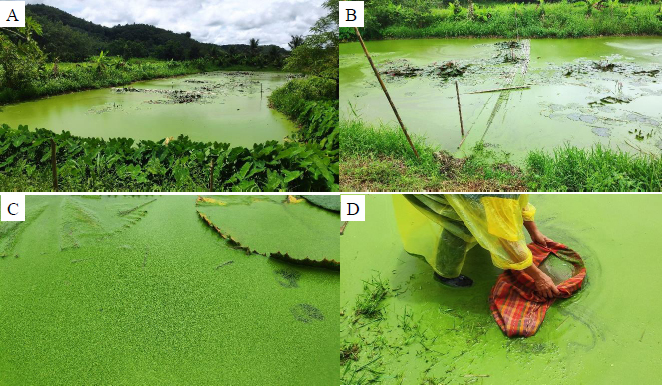
A man-made earthen pond where watermeal used in this study naturally grows. Nymphaea sp. grows in the pond along with watermeal. The pond is located at Namuang Village, Sri-Songrak Subdistrict, Muang District, Loei Province, and its size is approximately 1,600 m2. Watermeal appears in the pond all year round without fertilization and becomes denser during the monsoon. :The water in the pond had a pH of 6.93 and EC of 351 µS/cm. The photos were taken on September 19, 2025, in the morning after rain. (A-B) the pond; (C) watermeal mat; and (D) harvesting watermeal by the farmer.
Experiment 1: The first experiment comprised eight treatments and four replications. A completely randomized design was used in Experiment 1. The eight treatments included different OLF rates on a mL of OLF per Litre of water basis, being 0, 0.5, 1.0, 1.5, 2.0, 2.5, 3.0, and 3.5 mL/L. The number of four replications was expected to be sufficient to detect differences among the eight treatments. 4 L of rainwater was prepared in each 11-L plastic container. OLF was added at the desired rates (0, 2, 4, 6, 8, 10, 12, and 14 mL for treatments 1-8, respectively), and then the medium in each container was stirred thoroughly. 15 g of watermeal was grown as the starting mass in each container (310.40 g/m2), and the medium was stirred again to let the plant be evenly distributed. The plastic containers used were 29 and 21 cm in diameter on top and bottom, respectively, with a height of 23.5 cm (Fig. 4A). The plastic containers were placed outdoors on soil ground and covered tightly with 50% black shade cloth to prevent mosquitoes from laying eggs. Experiment 1 was run for a period of 11 days from 13 - 24 August 2025. Initially, the author planned to harvest the crop at 14 days. However, it was necessary to harvest at 11 days; otherwise, the media, together with watermeal, would overflow from the containers due to the high amount of rainfall accumulation during that period. The shade cloth was uncovered once on day 11 for harvest.
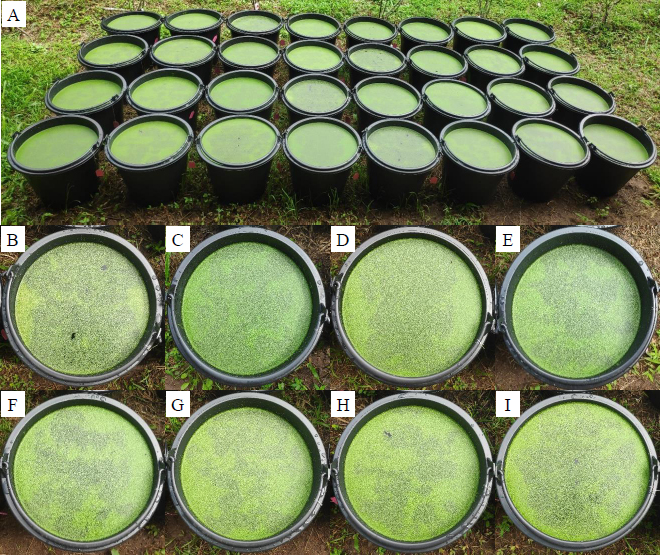
Experiment 1 showing W. globosa at 11 days after growth in eight OLF treatments with four replications: (A) 32 experimental units; (B) OLF 0 mL/L; (C) OLF 0.5 mL/L; (D) OLF 1.0 mL/L; (E) OLF 1.5 mL/L; (F) OLF 2.0 mL/L; (G) OLF 2.5 mL/L; (H) OLF 3.0 mL/L; and (I) OLF 3.5 mL/L.
Experiment 2: The second experiment consisted of three treatments and four replications (blocks). A randomized complete block design was the design used in Experiment 2. The three treatments included OLF 1.5, 2.5, and 3.5 mL/L. The number of four replications was expected to be sufficient to detect differences among the three treatments. 120 L of tap water was prepared in each cement pond. The cement ponds used were 1.2-m diameter with 6-cm bottom thickness, 1.12-m inner diameter and 0.43-m inner height (Fig. 5A). OLF was added at the desired rates (180, 300, and 420 mL for treatments 1-3, respectively), and then the medium in each container was stirred thoroughly. 200 g of watermeal was grown as the starting mass in each cement pond (202.92 g/m2), as shown in Fig. (5B), and the medium was stirred again to let the plant be evenly distributed. The previous crops grown in the cement ponds were lotus (Nelumbo nucifera) and water lilies (unidentified species in the Nymphaeaceae family). The cement ponds were installed in 2019. Therefore, the problem of alkaline water in the pond disappeared in this study, considering that water in new cement ponds is alkaline because the dissolution of cement increases the pH of water.
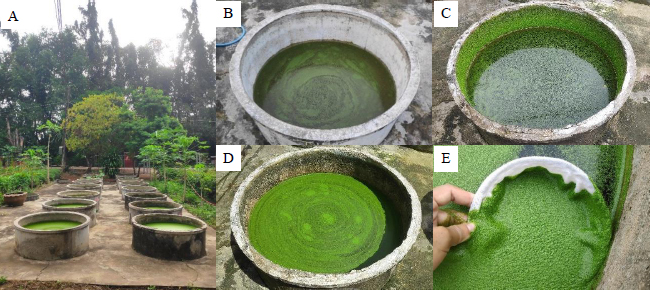
Experiment 2 showing W. globosa during the experiment: (A) in 12 experimental units; (B) 200 g as starting mass (202.92 g/m2); (C) splashing onto the pond edge after rain; (D) floating on water after washing the pond following rain; and (E) harvesting at 30 days using a cotton bag.
Experiment 2 was run for a period of 30 days from 25 September to 25 October 2025. On days 2 - 29, the medium in each pond was manually stirred 1-2 times a day for 1-2 minutes each to increase dissolved oxygen. 12- and 100-mL effective microorganisms (EM®) were added to each pond on day 2 and 5, respectively, to reduce the fishy odor of OLF. EM® consisted of three groups of microorganisms, including photosynthetic bacteria, lactic acid bacteria, and yeast. EM can be used to eliminate the strong odor of organic fertilizer, as reported in reducing the bad smell of poultry manure by [20]. The group of photosynthetic bacteria in EM was responsible for eliminating the strong odor [21]. 200 and 300 mL OLF were added to each pond on day 10 and 20, respectively, to fertilize watermeal as rainfall diluted EC and altered the culture volume. A similar quantity of OLF was used across the three treatments to maintain suitable EC; otherwise, EC would be too low in treatment 1 if a proportional quantity of OLF were added. Consequently, the final cumulative OLF input at 30 days for treatments 1-3 was 680, 800, and 920 mL (5.67, 6.67, and 7.67 mL/L) per pond.
Rainfall during the experiment caused the medium, together with watermeal, to splash onto the pond edge (Fig. 5C). Thus, the pond edge was washed after rain using the medium in the pond to let watermeal float back on the medium (Fig. 5D). Snails and slugs were frequently found in the ponds in the morning if it rained at night. Consequently, they were removed from the ponds.
2.2. Preparation of OLF
A total of 24.4 kg of fish waste donated by a local wholesale store was used to prepare OLF. The fish waste comprised freshwater fish waste (Oreochromis niloticus and Clarias sp.) and marine fish waste (Lates calcarifer), mostly freshwater fish waste, with no salt or preservatives. The fish waste included 17.5 kg whole fish, 2.4 kg fish head, and 4.5 kg minced fish. 20 L of tap water was added to a plastic container, followed by 25 g ‘Microbial Activator Super LDD 2 ’, and then the solution was stirred thoroughly. ‘Microbial Activator Super LDD 2’ is a highly efficient microorganism that can stimulate the fermentation and digestion process of organic waste for producing organic liquid fertilizer [22]. It is a product not for sale from the Land Development Department, Ministry of Agriculture and Cooperatives, Government of Thailand. The microorganisms include yeast, lactic acid bacteria, proteolytic bacteria, lipolytic bacteria, and phosphate-solubilizing bacteria. The 24.4 kg of fish waste was put in a 100-L plastic container located in dappled shade, followed by 20 L of highly concentrated molasses (80 Brix) and then the Microbial Activator Super LDD 2 mixture. 20 L of tap water was further added to the fish waste mixture. The mixture was stirred thoroughly, and then the container was covered with the lid. During the fermentation and digestion period, the fish waste mixture was stirred regularly for 1-2 minutes and covered with the lid after stirring. In the first week, the fish waste mixture was stirred daily. In the next three weeks, it was stirred two to three times a week. In the remaining time, the mixture was stirred once a week. After 4 months, the product was filtered by a strainer and stored for further use. pH of OLF was 3.93-4.15. Electrical conductivity (EC) of OLF was 42,000-44,000 μS/cm.
2.3. Nutrient Analysis of OLF
Nutrient analysis of OLF in this study was conducted eight months after the fermentation process began. OLF was analyzed for % liquid product for six macronutrients, including total N, total P, total K, total Ca, total Mg, and total S. The results were: 1% total N, 0.29% total P, 0.66% total K, 0.68% total Ca, 0.14% total Mg, and 0.16% total S. Total N was determined using the Kjeldahl method. Total P was analyzed using wet digestion and spectrophotometry. Determination of total K, Ca, and Mg was based on wet digestion and atomic absorption spectrophotometry. Total S was analyzed using wet digestion, turbidity, and spectrophotometry.
2.4. Data Collection
The pH and EC (μS/cm) of the media, biomass (g), and average daily biomass gain (g/day) of watermeal were recorded in both experiments. In Experiment 1, pH and EC were recorded twice: before cultivation and after harvest, while biomass and average daily biomass gain were recorded after harvest. Rainwater used in Experiment 1 had a baseline EC of 4 µS/cm and pH of 6.93. In Experiment 2, pH and EC were recorded nine times: 0, 5, 10, 15, 20, 25, and 30 days after cultivation and on days 10 and 15 after applying OLF to the media. Tap water used in Experiment 2 had a baseline EC of 245 µS/cm and pH of 7.40. Biomass was evaluated every five days for a period of 30 days, at 5, 10, 15, 20, 25, and 30 days after cultivation. The period of 30 days was chosen because days of cultivation that gave the greatest biomass within 30 days could be observed. After recording biomass, watermeal was placed back in the corresponding ponds, followed by stirring. Biomass per unit area (g/m2), average daily biomass gain (g/day) according to [10], and daily productivity (g/m2/day) according to [23] at six times of harvest were obtained from the following formulas:
average daily biomass gain (g/day) = biomass (g)/duration (days)
daily productivity (g/m2/day) = [biomass (g)/pond area (m2)]/duration (days).
Daily productivity (g/m2/day) represents mean biomass accumulation per unit area and time. In Experiment 1, fine strainers were used to harvest the floating watermeal in the containers. In Experiment 2, cotton bags were used to harvest the floating watermeal in the ponds (Fig. 5E).
2.5. Statistical Analysis
Data were analyzed using SAS OnDemand for Academics. Analyses of variance for pH, EC, biomass, biomass per unit area, average daily biomass gain, and daily productivity were performed using PROC MIXED with treatment considered a fixed effect, and replication considered a random effect. Tukey’s honestly significant difference was used as a post hoc test to perform pairwise comparisons of all treatments in the analyses of variance (p = 0.05).
3. RESULTS AND DISCUSSION
Experiment 1: Significant differences for pH, EC, biomass, and average daily biomass gain at harvest were observed among the eight OLF treatments as shown in Table 1 and Figs. (4A-4I). There were trends that increased rates of OLF led to greater EC, biomass, and average daily biomass gain but lower pH. Biomass from the treatment with zero OLF was below the starting mass of 15 g, and average daily biomass gain was below zero, showing that some watermeal died when grown without fertilization. pH became lower with the increased OLF rates because OLF was strongly acidic. When the quantity was higher, the acidity became stronger. After 11 days of growth, all acidic media had increased pH, and rainfall accumulation may underlie the cause to some extent (Fig. 2). EC was higher with the increased OLF rates. EC is a general indicator of ionic concentration. However, EC may be used to predict nutrient availability in this study, as the source of nutrients across the treatments was similar, which was OLF. When the concentration of OLF was higher, the EC value was higher. The rainfall accumulation of 101.3 mm at harvest made EC decrease more than two times from day 0 in all OLF treatments.
| Treatment | pH | EC (µS/cm) | Biomass (g) | Average Daily Biomass Gain (g/day) | ||
|---|---|---|---|---|---|---|
| Day | Day | Day | Day | |||
| 0 | 11 | 0 | 11 | 11 | 11 | |
| OLF 0 mL/L | 6.93 | 7.42 a | 4.00 | 4.5 f | 13.66 c | -0.12 c |
| OLF 0.5 mL/L | 4.70 | 7.15 ab | 62.00 | 22.0 ef | 22.41 bc | 0.67 bc |
| OLF 1.0 mL/L | 4.32 | 6.98 b | 104.00 | 30.0 de | 22.12 bc | 0.65 bc |
| OLF 1.5 mL/L | 4.16 | 6.83 b | 138.00 | 49.0 cd | 27.25 ab | 1.11 ab |
| OLF 2.0 mL/L | 4.09 | 6.89 b | 178.00 | 66.0 c | 32.53 ab | 1.59 ab |
| OLF 2.5 mL/L | 4.08 | 6.94 b | 252.00 | 94.0 b | 29.20 ab | 1.29 ab |
| OLF 3.0 mL/L | 4.06 | 6.95 b | 296.00 | 108.5 b | 30.50 ab | 1.41 ab |
| OLF 3.5 mL/L | 4.03 | 6.91 b | 344.00 | 138.5 a | 36.62 a | 1.97 a |
| Mean | 4.55 | 7.01 | 172.25 | 64.06 | 26.78 | 1.07 |
| Standard Error | - | 0.09 | - | 4.15 | 2.30 | 0.21 |
| Degree of freedom | - | 24 | - | 24 | 24 | 24 |
| F-value | - | 4.31 | - | 125.44 | 9.81 | 9.81 |
| P-value | - | 0.0032 | - | <.0001 | <.0001 | <.0001 |
| F-test | - | ** | - | ** | ** | ** |
Estimates within the same column followed by the same letter are not significantly different at the 0.05 probability level according to the Tukey’s Honestly Significant Difference test.
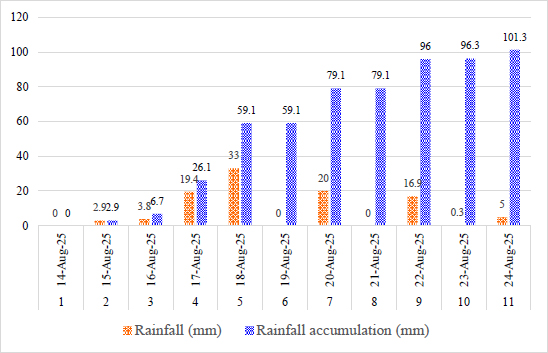
Rainfall accumulation during 11 days of running Experiment 1. Rainfall was collected on 14-24 August 2025.
Estimates within the same column followed by the same letter are not significantly different at the 0.05 probability level according to Tukey’s Honestly Significant Difference test.
Experiment 2: pH was consistent across the experimental period from day 0 to day 30, with pH being lower at higher rates of OLF, similar to Experiment 1 (Table 2). pH in all treatments decreased after adding OLF to the ponds, as expected. pH in the three treatments increased from day 0 to day 10, from day 10 after adding OLF to day 20, and from day 20 after adding OLF to day 30. Thus, in addition to fertilizing watermeal, adding OLF helped lower the pH to near 7.00, which was suitable for plant growth. The increase in pH level over time may be associated with watermeal photosynthesis, which was related to CO2 concentration [24]. CO2 reacts with water and then forms carbonic acid. Consequently, the likely mechanism was that when CO2 was consumed by watermeal for photosynthetic activities, water became more alkaline.
| Treatment | Day | ||||||||
|---|---|---|---|---|---|---|---|---|---|
| 0 | 5 | 10 |
10 + OLF |
15 | 20 |
20 + OLF |
25 | 30 | |
| OLF 1.5 mL/L | 6.07 a | 7.31 a | 7.87 | 7.28 | 7.65 | 7.98 a | 7.09 | 7.66 | 8.05 a |
| OLF 2.5 mL/L | 5.63 b | 7.26 a | 7.87 | 7.41 | 7.54 | 7.70 ab | 7.07 | 7.39 | 7.98 a |
| OLF 3.5 mL/L | 5.07 c | 7.13 b | 7.74 | 7.45 | 7.40 | 7.46 b | 7.03 | 7.23 | 7.68 b |
| Mean | 5.59 | 7.23 | 7.82 | 7.38 | 7.53 | 7.71 | 7.07 | 7.42 | 7.90 |
| Standard Error | 0.01 | 0.06 | 0.05 | 0.05 | 0.07 | 0.12 | 0.03 | 0.13 | 0.07 |
| Degree of freedom | 6 | 6 | 6 | 6 | 6 | 6 | 6 | 6 | 6 |
| F-value | 2684.49 | 9.9 | 3.95 | 3.03 | 3.83 | 11.95 | 0.85 | 3.11 | 8.66 |
| P-value | <.0001 | 0.0126 | 0.0804 | 0.1231 | 0.0846 | 0.0081 | 0.4732 | 0.1186 | 0.017 |
| F-test | ** | * | ns | ns | ns | ** | ns | ns | * |
20+OLF, day 20 after adding OLF 300 mL per pond.
ns, not significant.
*, ** Significant at the 0.05 and 0.01 probability levels, respectively.
Estimates within the same column followed by the same letter are not significantly different at the 0.05 probability level according to the Tukey’s Honestly Significant Difference test.
EC was consistent across the experimental period from day 0 to day 30, with EC being higher at higher rates of OLF, similar to Experiment 1 (Table 3). EC in all treatments increased after adding OLF to the ponds, as expected. EC in the three treatments decreased from day 0 to day 10 and from day 10 to day 20 after adding OLF due to rainfall accumulation (Fig. 3). However, EC in all treatments increased from day 20 after adding OLF to day 30, in contrast with earlier periods. This was because there was no rain from day 21 to day 30. Consequently, water evaporated from the ponds, leading to greater values of EC.
| Treatment | Day | ||||||||
|---|---|---|---|---|---|---|---|---|---|
| 0 | 5 | 10 |
10 + OLF |
15 | 20 |
20 + OLF |
25 | 30 | |
| OLF 1.5 mL/L | 372.5 c | 253.0 c | 194.0 c | 273.5 | 265.75 | 229.25 | 278.00 | 316.25 | 315.50 |
| OLF 2.5 mL/L | 449.0 b | 321.5 b | 235.0 b | 300.5 | 276.00 | 240.00 | 284.75 | 325.00 | 329.00 |
| OLF 3.5 mL/L | 525.0 a | 359.0 a | 265.0 a | 323.5 | 290.25 | 253.25 | 298.50 | 342.00 | 351.75 |
| Mean | 448.83 | 311.17 | 231.33 | 299.17 | 277.33 | 240.83 | 287.08 | 327.75 | 332.08 |
| Standard Error | 3.31 | 7.23 | 6.00 | 11.76 | 8.92 | 10.15 | 9.83 | 12.44 | 12.27 |
| Degree of freedom | 6 | 6 | 6 | 6 | 6 | 6 | 6 | 6 | 6 |
| F-value | 558.15 | 55.23 | 39.84 | 4.53 | 1.9 | 1.4 | 1.13 | 1.11 | 2.23 |
| P-value | <.0001 | 0.0001 | 0.0003 | 0.0632 | 0.229 | 0.3162 | 0.3833 | 0.3897 | 0.1888 |
| F-test | ** | ** | ** | ns | ns | ns | ns | ns | ns |
20+OLF, day 20 after adding OLF 300 mL per pond.
ns, not significant.
** Significant at the 0.01 probability level.
Estimates within the same column followed by the same letter are not significantly different at the 0.05 probability level according to the Tukey’s Honestly Significant Difference test.
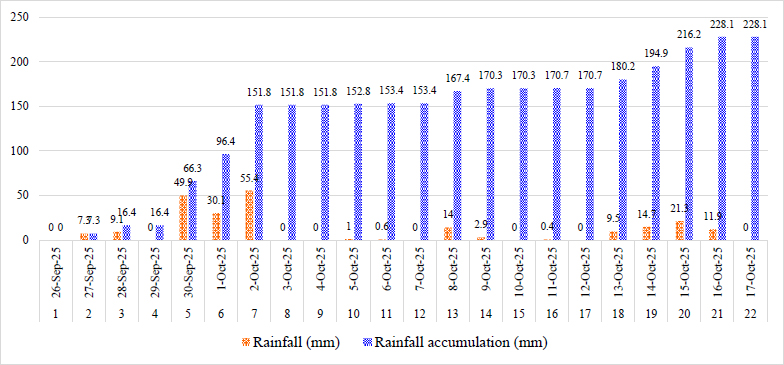
Rainfall accumulation during 30 days of running Experiment 2. Rainfall was collected from 26 September to 25 October 2025. There was no rain on days 23 to 30.
In general, watermeal biomass (g) and biomass per unit area (g/m2) were greater with the increased OLF rates, although treatments 2.5 and 3.5 mL/L were not statistically different from day 15 onward (Tables 4 and 5 and Fig. 6). It is worth noting that the two traits from OLF 2.5 mL/L were closer to OLF 3.5 mL/L than OLF 1.5 mL/L. Biomass per unit area exceeded 2 kg/m2 in the OLF 3.5 mL/L treatment after 30 days of growth, which was about ten times greater than the starting biomass per unit area (202.92 g/m2). The value represented the thick mat of watermeal as shown in Fig. (5E) compared with naturally grown watermeal in the farmer’s pond shown in Fig. (1C).
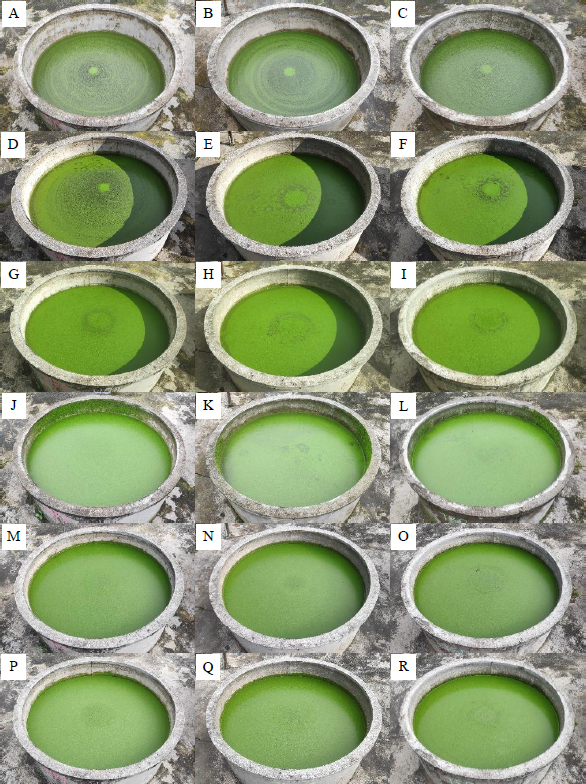
Experiment 2 showing W. globosa at 5, 10, 15, 20, 25, and 30 days after growth. The columns and rows represent the treatments and days after growth, respectively. The first column (A, D, G, J, M, and P) shows the treatment OLF 1.5 mL/L. The second column (B, E, H, K, N, and Q) shows the treatment OLF 2.5 mL/L. The third column (C, F, I, L, O, and R) shows the treatment OLF 3.5 mL/L. (A-C) 5 days; (D-F) 10 days; (G-I) 15 days; (J-L) 20 days; (M-O) 25 days; and (P-R) 30 days.
| Treatment | Day | |||||
|---|---|---|---|---|---|---|
| 5 | 10 | 15 | 20 | 25 | 30 | |
| OLF 1.5 mL/L | 439.00 | 510.07 c | 932.68 b | 1,075.10 | 1,218.38 b | 1,279.25 b |
| OLF 2.5 mL/L | 521.25 | 711.45 b | 1,127.43 ab | 1,360.55 | 1,641.50 ab | 1,931.43 ab |
| OLF 3.5 mL/L | 520.83 | 814.47 a | 1,201.35 a | 1,525.25 | 1,783.53 a | 2,140.43 a |
| Mean | 493.69 | 678.66 | 1,087.15 | 1,320.30 | 1,547.80 | 1,783.70 |
| Standard Error | 45.47 | 19.71 | 57.38 | 120.28 | 118.46 | 184.38 |
| Degree of freedom | 6 | 6 | 6 | 6 | 6 | 6 |
| F-value | 2.53 | 65.74 | 5.85 | 3.59 | 6.16 | 5.93 |
| P-value | 0.1597 | <.0001 | 0.039 | 0.0945 | 0.0351 | 0.0379 |
| F-test | ns | ** | * | ns | * | * |
*, ** Significant at the 0.05 and 0.01 probability levels, respectively.
Estimates within the same column followed by the same letter are not significantly different at the 0.05 probability level according to the Tukey’s Honestly Significant Difference test.
| Treatment | Day | |||||
|---|---|---|---|---|---|---|
| 5 | 10 | 15 | 20 | 25 | 30 | |
| OLF 1.5 mL/L | 445.41 | 517.53 c | 946.30 b | 1,090.81 | 1,236.18 b | 1,297.94 b |
| OLF 2.5 mL/L | 528.87 | 721.84 b | 1,143.90 ab | 1,380.43 | 1,665.48 ab | 1,959.64 ab |
| OLF 3.5 mL/L | 528.43 | 826.37 a | 1,218.90 a | 1,547.53 | 1,809.58 a | 2,171.70 a |
| Mean | 500.90 | 688.58 | 1,103.03 | 1,339.59 | 1,570.41 | 1,809.76 |
| Standard Error | 46.13 | 19.99 | 58.22 | 122.04 | 120.19 | 187.08 |
| Degree of freedom | 6 | 6 | 6 | 6 | 6 | 6 |
| F-value | 2.53 | 65.74 | 5.85 | 3.59 | 6.16 | 5.93 |
| P-value | 0.1597 | <.0001 | 0.039 | 0.0945 | 0.0351 | 0.0379 |
| F-test | ns | ** | * | ns | * | * |
*, ** Significant at the 0.05 and 0.01 probability levels, respectively.
Estimates within the same column followed by the same letter are not significantly different at the 0.05 probability level according to the Tukey’s Honestly Significant Difference test.
Again, watermeal average daily biomass gain (g/day) and daily productivity (g/m2/day) increased with the increase in OLF rates, similar to biomass and biomass per unit area (Tables 6-7). Among the six biomass measurements, average daily biomass gain of the three treatments was the highest on day 15, while daily productivity was the highest on day 5 and tended to decrease until day 30. Environmental factors for watermeal growth may be optimal after 15 days of growth, resulting in the highest average daily biomass gain.
| Treatment | Day | |||||
|---|---|---|---|---|---|---|
| 5 | 10 | 15 | 20 | 25 | 30 | |
| OLF 1.5 mL/L | 47.80 | 31.01 c | 48.85 b | 43.76 | 40.74 b | 35.98 b |
| OLF 2.5 mL/L | 64.25 | 51.15 b | 61.83 ab | 58.03 | 57.66 ab | 57.71 ab |
| OLF 3.5 mL/L | 64.17 | 61.45 a | 66.76 a | 66.26 | 63.34 a | 64.68 a |
| Mean | 58.74 | 47.87 | 59.14 | 56.02 | 53.91 | 52.79 |
| Standard Error | 9.09 | 1.97 | 3.83 | 6.01 | 4.74 | 6.15 |
| Degree of freedom | 6 | 6 | 6 | 6 | 6 | 6 |
| F-value | 2.53 | 65.74 | 5.85 | 3.59 | 6.16 | 5.93 |
| P-value | 0.1597 | <.0001 | 0.039 | 0.0945 | 0.0351 | 0.0379 |
| F-test | ns | ** | * | ns | * | * |
*, ** Significant at the 0.05 and 0.01 probability levels, respectively.
Estimates within the same column followed by the same letter are not significantly different at the 0.05 probability level according to the Tukey’s Honestly Significant Difference test.
| Treatment | Day | |||||
|---|---|---|---|---|---|---|
| 5 | 10 | 15 | 20 | 25 | 30 | |
| OLF 1.5 mL/L | 89.08 | 51.75 c | 63.09 b | 54.54 | 49.45 b | 43.26 b |
| OLF 2.5 mL/L | 105.77 | 72.18 b | 76.26 ab | 69.02 | 66.62 ab | 65.32 ab |
| OLF 3.5 mL/L | 105.69 | 82.64 a | 81.26 a | 77.38 | 72.38 a | 72.39 a |
| Mean | 100.18 | 68.86 | 73.54 | 66.98 | 62.82 | 60.33 |
| Standard Error | 9.23 | 2.00 | 3.88 | 6.10 | 4.81 | 6.24 |
| Degree of freedom | 6 | 6 | 6 | 6 | 6 | 6 |
| F-value | 2.53 | 65.74 | 5.85 | 3.59 | 6.16 | 5.93 |
| P-value | 0.1597 | <.0001 | 0.039 | 0.0945 | 0.0351 | 0.0379 |
| F-test | ns | ** | * | ns | * | * |
*, ** Significant at the 0.05 and 0.01 probability levels, respectively.
Estimates within the same column followed by the same letter are not significantly different at the 0.05 probability level according to the Tukey’s Honestly Significant Difference test.
In this study, watermeal could grow in a pH range of 4.03-8.05, which agrees with [25], who reported that duckweeds survive in a pH range of 3.5-9.0. After 11 days of growth in Experiment 1, biomass in the treatments OLF 1.5, 2.5, and 3.5 mL/L was 1.8-2.4 times greater than the starting mass, with rainfall accumulated during the 11-day period of 101.3 mm. After ten days of growth in Experiment 2, biomass in the three similar treatments was 2.6-4.1 times greater than the starting mass, with rainfall accumulated during period of the 10 days of 153.4 mm. Although rainfall accumulated was higher, referring to less nutrients per unit volume in Experiment 2, biomass increase was greater than Experiment 1. Light may be the main cause, as watermeal received full sunlight in Experiment 2 but only half the intensity in Experiment 1. This finding was consistent with [26], which reported that the biomass of watermeal cultured under full sunlight was greater than that of watermeal cultured at 50% light intensity. However, gas exchange level might play a role to some extent. Manual stirring was practiced daily in Experiment 2, leading to higher gas exchange than in Experiment 1, while gas exchange in Experiment 1 could occur only with rain. Average daily biomass gain was incomparable between the two experiments since biomass per unit area of watermeal when the experiments began was different. In Experiment 1, biomass per unit area was 310.40 g/m2, while biomass per unit area in Experiment 2 was 202.92 g/m2.
Among the five measurements of Experiment 2, the three OLF treatments (1.5, 2.5, and 3.5 mL/L) had the highest average daily biomass gain at 15 days of growth (48.85-66.76 g/day) and the highest daily productivity at five days of growth (89.08-105.77 g/m2/day). With these findings, one crop of watermeal cultivation may take 15 days rather than 30 days, as average daily biomass gain reached a peak at 15 days. Considering treatment 3.5 mL/L, biomass at 15 and 30 days was 1,201.35 and 2,140.43 g, respectively. If watermeal is harvested at 15 days and then the whole process is restarted from the beginning with the new media, biomass for two crops of cultivation in 30 days will be 2,402.7 g (1,201.35 g x 2). This yield is greater than one crop of cultivation with a 30-day harvest (2,140.43 g). Therefore, farmers may harvest watermeal at 15 days and then restart all process of cultivation, including replacing water, to maximize watermeal biomass. However, the days to harvest watermeal are optional for farmers.
OLF promotes environmentally friendly cultivation of W. globosa as it is an organic product. OLF contains sufficient nutrients for plant growth with 1% total N, 0.29% total P, 0.66% total K, 0.68% total Ca, 0.14% total Mg, and 0.16% total S. This has made OLF an efficient fertilizer for W. globosa. Furthermore, OLF may be productive in the cultivation of other aquatic crops. The proper range of media EC is crucial for the cultivation of watermeal using OLF because watermeal cannot tolerate high EC. Consequently, rates of OLF use may differ with seasons in watermeal cultivation using OLF. In the monsoon, with rainwater available, the OLF rate is higher than in other seasons. Rainwater is soft water with an EC close to 0; thus, a higher rate of OLF can be applied to the water, leading to higher nutrients per unit volume for watermeal growth. However, rain makes husbandry of open cement ponds more difficult during the monsoon season. In addition, different OLFs may have different EC. Thus, the rate of OLF use to cultivate watermeal may differ in different cultivation environments. As an edible plant, microbial contamination from OLF is a major concern for watermeal cultivation. However, watermeal is a vegetable that is eaten only after being cooked. Therefore, if the plant is clean and cooked thoroughly, it is safe for consumption.
CONCLUSION
W. globosa can be fertilized with OLF without changing media for a period of 30 days under the conditions of this study. OLF 3.5 mL/L tended to give the greatest biomass and biomass per unit area of all five measurements. After 30 days of growth, OLF 3.5 mL/L gave biomass per unit area over 2 kg/m2, which was about ten times higher than the starting biomass per unit area (202.92 g/m2). The average daily biomass gain was the highest at 15 days, suggesting that one crop of watermeal cultivation may be 15 days instead of 30 days, with a new process of cultivation including a new set of water and OLF to maximize yield. Increasing gas exchange is necessary for watermeal cultivation in small-scale farms even during the monsoon. For further exploration, tap water, in addition to rainwater, should be studied to cultivate watermeal when fertilized with OLF, as rainwater is available only during the monsoon, whereas tap water is available year-round. Cultivation using tap water can be done in the winter as the temperature is suitable for watermeal growth.
The study was conducted during a single monsoon season and at a single location. Nutritional quality analysis and microbial safety testing of harvested W. globosa should be investigated in future work, as both were absent in this study. Comparisons between OLF and conventional inorganic fertilizers in terms of yield and cost-effectiveness data were not made in this study. Different OLF batches may have different properties because species composition may affect the nutrient profile of OLF. Different environments, including areas and times of the year, can affect watermeal production, as environmental factors such as rainfall, temperature, and humidity affect watermeal growth. Especially, rainfall is an uncontrolled factor that strongly affects watermeal production. A number of replications greater than four is recommended for further studies using cement ponds. It requires close attention to cultivate watermeal in open areas using cement ponds during the monsoon. Consequently, farmers may replace cement ponds with other types of ponds that allow watermeal not to stick to the pond edge. However, the other types of ponds may lead to higher temperatures and have higher costs than cement ponds.
AUTHOR'S CONTRIBUTIONS
The author confirms sole responsibility for the following: study conception and design, data collection, analysis and interpretation of results, and manuscript preparation.
LIST OF ABBREVIATIONS
| EC | = Electrical conductivity |
| EM | = Effective microorganisms |
| OLF | = Organic liquid fertilizer from fish |
AVAILABILITY OF DATA AND MATERIALS
The data supporting the findings of the article are available on Figshare at https://doi.org/10.6084/m9.fig share.31055512, reference number 10.6084/m9.fig share.31055512.
ACKNOWLEDGEMENTS
The author is thankful to Loei Rajabhat University for providing the fund. Thanks are also due to some undergraduate students of Agriculture Program, Department of Applied Science, Faculty of Science and Technology, Loei Rajabhat University for some experiment works. The author would like to express gratitude to the local supermarket for the fish waste donation, which was used in this study. The author would like to thank the farmer for showing the natural watermeal in her farmland.