All published articles of this journal are available on ScienceDirect.

Potential of Organic Lavender and Peppermint Essential Oils Against Sucking Insects in Oil-bearing Rose Plantations

Abstract
The present study aims to establish the effectiveness of organic essential oils extracted from lavender (Lavandula angustifolia Mill) and peppermint (Mentha piperita) on some sucking insects in organic oil-bearing rose plantations. The contact action of 2%, 4%, and 6% essential oil solutions has been tested on Macrosiphum rosae L, Thrips tabaci, and Tetranychus urticae Koch, identified as the most important and common sucking insects on oil-bearing roses. The study was conducted in an organic rose plantation located in the region of the village Kliment between 2023 and 2025. The field experiment was organised according to the randomised block design with four replications and a plot size of 18 m2. The study finds that as the solution concentration increases, its effectiveness increases. The 6% lavender essential oil solution reduced the populations of Thrips tabaci and the green rose aphid by up to 41%, and that of the two-spotted spider mite by up to 27%. The highest concentration of peppermint essential oil showed efficacy of up to 30% against Thrips tabaci, up to 34% against the green rose aphid, and up to 21% against the two-spotted spider mite. While essential oil solutions do not match the efficacy of the commercial organic insecticide Limocide®, their effectiveness makes them a valuable addition to plant protection strategies aimed at reducing conventional chemical pesticides and promoting sustainable agriculture. Essential oils hold significant potential that requires careful research to optimize their use. Further investigations are necessary to improve their field performance while safeguarding non-target organisms and human health.
1. INTRODUCTION
During the vegetation period, the rose plant could be attacked by various pests, which can not only compromise the growth of the flowers, but also negatively affect the quality of the essential oil [1]. Often underestimated, insects with piercing-sucking mouthparts coming from the Tetranychidae, Thripidae, and Aphididae are capable of causing significant damage to agricultural crops. Their control is challenging because of the developed resistance to chemical pesticides and their high productive potential. Alternative approaches that can complement plant protection initiatives and help achieve a sustainable production process are becoming increasingly popular.
Plants consist of chemical substances, some of which are not directly beneficial for their growth and development. Essential oils are metabolites produced by higher plants, which are localised in different plant parts. Their role is to attract insects, to inhibit the germination of other plants' seeds, to protect the plants from insect attack, and to prevent the development of microorganisms and infection spread [2]. Natural pesticides based on plant extracts, such as rotenone, nicotine, and pyrethrum, were widely used in pest control during the early half of this century. Botanical pesticides are naturally occurring chemicals derived from plants. They are an excellent alternative to synthetic pesticides, helping reduce negative impacts on human health and the environment. Insecticides based on essential oils and their components have proven their effectiveness against various storage pests of cereal products [2]. Essential oils are known to have insecticidal, repellent, and antifeedant action, but they could also modify the growth and reproduction of the insects [3]. They can cause neurotoxicity by inhibiting insect receptors and by modifying their neuronal activity [3]. Essential oils are mainly composed of terpene compounds, predominantly monoterpenes (C10) and sesquiterpenes (C15), as well as a variety of aromatic phenols, oxides, ethers, alcohols, esters, aldehydes, and ketones, which define their characteristic scent and properties. The presence of volatile monoterpenes or essential oils in plants protects against biting or piercing-sucking insect mouthparts, as well as against some phytopathogenic fungi. These volatile terpene compounds play a crucial role in plant interactions and attract pollinators [4]. A study investigated the insecticidal effect of oils from lavender, eucalyptus, and rosemary against the adults of Acanthoscelides obtectus and found that, when applied in a dose of 0.8-41.7 mg depending on the sex of the insect, all monoterpenes except for linalyl and terpinyl acetate led to 100% mortality of the pest [5]. Among the tested monoterpenoids, terpinene-4-ol, 1,8-cineole, verbenone, and camphor showed the highest effectiveness against the adults of A. obtectus. If in the past the populations of these pests were effectively controlled by increasing the doses of insecticides or by applying new synthetic active substances, the developed resistance of insects to the active substances requires the implementation of new strategies and approaches [6]. Synthetic chemicals threaten human health, pollute soils, and cause loss of biodiversity [7]. Several researchers have established that essential oils can be successfully used to control pests with piercing-sucking mouthparts, particularly aphids [8, 9]. These secondary metabolites are primarily extracted by hydrodistillation [10], and their quantity and chemical composition can vary with numerous parameters, including botanical origin, geographic location, cultivation conditions, and climate [11]. The composition of essential oils mainly includes organic volatile compounds from the terpenoid family, as well as many other chemical groups such as esters, amines, amides, heterocycles, ethers, and oxides [12]. These compounds can have toxic effects on insects with piercing-sucking mouthparts [9], but they can also influence their biological activity, such as egg-laying, reproduction, feeding behaviour, and growth inhibition. Essential oils do not have harmful effects on non-target organisms such as natural enemies, pollinators, aquatic and soil organisms [12]. For this reason, essential oils can be used to control some economically important pests without threatening the environment and ecosystems. Some authors [13, 14] found that the multi-component nature of monoterpenes delays pest resistance. Due to their volatile character, essential oils rapidly degrade in real field conditions, which is the main factor limiting their wide implementation in practice. Recent research suggested alternative strategies, such as nanoencapsulation, emulsification, and integration with carriers such as chitosan, to increase the stability of the formulation [15]. Undertaking extensive field trials across various climate regions with different target insects is essential to estimate the practical value of the essential oils. In this regard, the present study aims to research the insecticidal effect of essential oils from organic lavender and peppermint on some economically important sucking insects in oil-bearing rose plantations. While most studies examine the laboratory effectiveness of essential oil solutions on individual target insects, the present study includes trials in a real-world setting with representatives from three different families: Thripidae, Tetranychidae, and Aphididae. For the first time, the effectiveness of essential oil solutions from lavender and mint is being studied for controlling insects with piercing-sucking mouthparts in organic oil-bearing rose plantations.
2. MATERIALS AND METHODS
2.1. Plant Material and Essential Oil Extraction
Plant material was collected from organically grown lavender and peppermint plantations in the region of the village of Tazha (42°38'42.0”N 25°04'49.8” E). The soils in the region are classified as Fluvosols with a slightly acid reaction. In climatic terms, the region is characterised by a continental climate, as the precipitation norms and the average monthly temperatures for the study period are presented in Fig. (1). For the purpose of the study, a 5-year-old plantation of lavender (Lavandula vera) variety Sevtopolis and a 2-year-old plantation of peppermint (Mentha piperita Huds.) variety Zephyr were used. The essential oil was extracted through hydrodistillation utilising a Clevenger-type apparatus. Fifteen grams of organic lavender flowers and organic mint leaves were subjected to 240 mL of water for 105 minutes. The obtained essential oil was stored at 4 °C in a refrigerator until gas chromatography analysis.
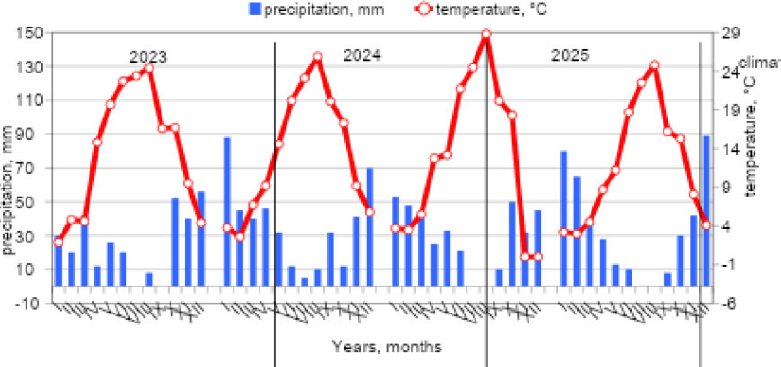
Climatic conditions during the tested period.
2.2. Chemical Composition of Essential Oils
The essential oils were analysed using a Hewlett-Packard 6890 gas chromatograph equipped with an autosampler, with helium as the carrier gas at a flow rate of 40 cm/s, operating at a pressure of 11.7 psi at 60 °C. The injection was carried out with a split ratio of 60:1, using 0.5 µL, and the inlet temperature was maintained at 220 °C. The oven temperature program involved an initial temperature of 60 °C held for 1 minute, followed by a ramp of 10 °C/minute up to 250 °C. The column employed was an HP-INNOWAX (cross-linked polyethene glycol) with dimensions of 30 m x 0.32 mm x 0.5 µm. The flame ionisation detector was maintained at a temperature of 275 °C. The identification of compounds was performed by comparing their mass spectra with data from Adams Library and the US National Institute of Standards and Technology (NIST, USA). The essential oils of lavender and peppermint were diluted in ethanol (96%) to prepare test solutions at concentrations of 2%, 4%, and 6% [16].
2.3. Field Experimental Setup
The study was conducted in an organic rose plantation located in the region of the village Kliment (W: 42.59699739096776, L: 24.682717358466093) over three consecutive years, 2023, 2024, and 2025. The field experiment was organised according to the randomised block design with four replications and a plot size of 18 m2 (comprising 21 plants per variant). Essential oil solutions (2% LEO (lavender essential oil), 4% LEO, 6% LEO, 2% MEO (Mint Essential Oil), 4% MEO, 6% MEO) were applied at a dose of 3 l/ha twice every seven days. The sprayings were carried out in the early morning hours in calm weather without strong winds using a Matabi Super Green backpack sprayer at a pressure of 1.5 - 3 bar and an average output of 0.5 l/min. The species affiliation of the target organisms was determined using an identification key by observing the characteristic features under a microscope. The estimation of the density of sucking insects such as mites, aphids, and thrips was performed using the washing method [17]. From each variant, 20 rose leaves and petals were collected and stored overnight in bottles filled with water and detergent. Subsequently, the contents of the bottles were rinsed through a sieve with a mesh diameter of 63 μm, allowing pests to be separated from the water. The different densities of sucking insects were then counted at 25× magnification using a stereomicroscope. Population density was recorded at intervals of 3, 5, and 7 days following treatment by documenting the number of living insects from each variant. In 2023, the first treatment was applied on 20 April, while in 2024, treatments commenced on 7 May. In the third year, the first treatment took place on 15 April. The treatments have been compared to an untreated control. The effectiveness of the essential oil solutions was compared to the organic insecticide Limocide® (60 g/L orange oil, manufacturer: Vivagro), which was applied in a dose of 2000 ml/ha. The effectiveness of the treatments was calculated on the 7th day after the second treatment using the Henderson–Tilton formula [18]. During the study period, no phytotoxic reactions were observed on leaves or other parts of the plants. The data analysis included ANOVA, with a significance level set at P<0.05.
3. RESULTS AND DISCUSSION
The chemical analysis of the lavender essential oil of the Sevtopolis variety allows for the identification of 13 components, with the percentage share of monoterpenes (linalool, lavender acetate, 1,8-cineole, limonene), which are responsible for the insecticidal properties, being the highest (Table 1). Essential oils from various Lavandula species are highly effective in controlling insects [5, 19, 20]. This effectiveness is mainly due to their key terpenic compounds, such as eucalyptol, linalool, camphor, and linalyl acetate. The analysis of peppermint oil managed to identify 17 components, of which, according to literature data, those with the most pronounced insecticidal properties are menthol, isomenthol, and terpenin-4-ol [21].
| Compound | RT (min) | Lavender Essential Oil | Compound | RT (min) | Peppermint Essential Oil |
|---|---|---|---|---|---|
| Linalool | 18.351 | 36.54 | Ethylacetoacetate | 26.864 | 0.28 |
| Linalyl acetate | 26.850 | 38.03 | Sabinene | 30.089 | 0.42 |
| cis-β-Ocimene | 14.908 | 5.26 | β-Pinene | 30.587 | 0.53 |
| Lavandulyl, acetate | 28.056 | 4.56 | Furfuril acetate | 31.190 | 5.12 |
| Terpinen-4-ol | 22.700 | 3.66 | Limonene | 34.827 | 4.89 |
| trans-β-Ocimene | 34.811 | 2.72 | Eucaliptol | 35.138 | 2.25 |
| 3-Octanone | 30.951 | 1.95 | α-Methylbenzylalcohol | 37.149 | 0.19 |
| α-Terpineol | 23.337 | 1.35 | Menthol | 37.345 | 65.23 |
| Limonene | 34.579 | 0.91 | Acephenone | 37.990 | 1.26 |
| Lavandulol | 32.778 | 0.71 | isoMenthol | 39.212 | 19.45 |
| 1,8-cineole | 33.383 | 0.37 | Ethyl heptanoate | 39.717 | 0.22 |
| β-phellandrene | 31.099 | 0.26 | 3-Acetylpyridine | 41.191 | 40.23 |
| Camphor | 44.726 | 0.15 | Terpenine-4-ol | 47.338 | 0.78 |
| - | - | - | cis-3-Hexenyl lactate | 48.257 | 0.28 |
| - | - | - | α-Terpineol | 48.540 | 1.12 |
| - | - | - | Octyl acetate | 48.857 | 0.63 |
| - | - | - | Linalyl acetate | 52.907 | 14.52 |
| - | - | - | Decyl acetate | 63.722 | 0.45 |
| - | - | - | Phenethyl butyrate | 66.447 | 3.12 |
The effectiveness of essential oil solutions under field conditions was calculated seven days after the second treatment, with the values being compared to the untreated variants. Regarding the control of the tobacco thrips, essential oil solutions cannot compete with the biological insecticide Limocidе®, which manages to reduce the pest population between 88% in the first year and 92% in the third year (Table 2). During the tested period, the highest efficiency was achieved when applying the highest concentration of 6% of the essential oil solutions, with lavender essential oil outperforming peppermint oil in effectiveness. Lavender oil applied at a concentration of 6% showed medium effectiveness and managed to reduce the pest population by between 38% and 41%, respectively, for the first and third year. Applied at the same concentration, peppermint oil shows effectiveness between 27% and 30%. Over the three years, the differences between the various concentrations of the essential oil solutions and the untreated control variant are statistically significant and proven. The high effectiveness of the product Limocid places it in a separate statistical group. On average for the period, the statistically insignificant differences between the individual concentrations of lavender and mint oil place them in the same statistical group.
| Variants | Number of Thrips tabaci | - | - | - | - | - | - |
|---|---|---|---|---|---|---|---|
| - | 2023 | - | 2024 | - | - | 2025 | - |
| - | 7 DAT | % E | - | 7 DAT | % E | 7 DAT | % E |
| 2% LEO | 59d | 21 | - | 72e | 23 | 95f | 24 |
| 4% LEO | 51d | 32 | - | 60d | 35 | 85e | 32 |
| 6% LEO | 47d | 38 | - | 57d | 39 | 74e | 41 |
| 2% MEO | 62e | 18 | - | 78e | 16 | 101f | 19 |
| 4% MEO | 57d | 24 | - | 70e | 25 | 94f | 25 |
| 6%MEO | 55d | 27 | - | 65e | 30 | 89e | 29 |
| Limocide® | 9a | 88 | - | 8a | 91 | 10a | 92 |
| Control | 75f | - | - | 93g | - | 125h | - |
| LSD0.05 | 12.50 | - | - | 14.10 | - | 15.80 | - |
**Values with the same letters do not differ significantly, according to the least significant difference test (P<0.05, Turkey's test).
***DAT- days after treatment, LEO -lavender essential oil, MEO-peppermint essential oil.
Regarding the control of the green rose aphid, unlike previous trials conducted in a controlled environment where 6% solutions manage to induce 50% (peppermint oil) or almost 100% mortality of the pest, in field conditions, the maximum level of effectiveness for lavender oil is 41%, while for peppermint oil it is 34% (Table 3). Once again, the biological insecticide shows the highest effectiveness compared to the untreated control over the average period, which can be explained by its high solution stability. The treatments with 4% and 6% solutions of peppermint oil do not lead to statistically significant differences between the variants, which places the two treatments in one statistical group. The effectiveness of essential oil solutions also depends on the test insect. The applied essential oil solutions show the lowest effectiveness against the two-spotted spider mite (Table 4). The lavender oil managed to reduce the population of the Tetranychus urticae between 8% (for the 2% solution in 2023) and 27% (for the 6% solution in 2025). With the peppermint oil, the effectiveness varies between 5% for the variant treated with a 2% solution in 2023 and 19% for the variant treated with a 6% solution in the third year. In the control against this pest, the commercial biological product Limocidе® shows the highest effectiveness of an average of 98% for the period of the study. No statistically significant differences were found between the concentrations of lavender and peppermint oil, and the individual variants were placed in the same statistical group. Nevertheless, the variants treated with different concentrations of essential oils differ significantly from the untreated control. It is noteworthy that over the three years of testing, the effectiveness of the essential oil solutions varied within narrow limits, which indicates stability of the solutions with respect to external environmental factors.
| Variants | Number of Macrosiphum rosae L. | - | - | - | - | - | - |
|---|---|---|---|---|---|---|---|
| - | 2023 | - | 2024 | - | - | 2025 | - |
| - | 7 DAT | % E | - | 7 DAT | % E | 7 DAT | % E |
| 2% LEO | 132f | 14 | - | 155f | 17 | 190f | 19 |
| 4% LEO | 109e | 29 | - | 130e | 30 | 160e | 32 |
| 6% LEO | 95d | 38 | - | 111e | 40 | 139e | 41 |
| 2% MEO | 131f | 15 | - | 153f | 18 | 202f | 14 |
| 4% MEO | 117e | 24 | - | 132e | 29 | 171e | 27 |
| 6%MEO | 106e | 31 | - | 123e | 34 | 158e | 33 |
| Limocide® | 11a | 93 | - | 15a | 92 | 7a | 97 |
| Control | 154g | - | - | 187h | - | 235g | - |
| LSD0.05 | 21.20 | - | - | 23.40 | - | 32.81 | - |
**Values with the same letters do not differ significantly, according to the least significant difference test (P<0.05, Turkey's test).
***DAT- days after treatment, LEO -lavender essential oil, MEO-peppermint essential oil.
| Variants | Number of Tetranychus urticae | - | - | - | - | - | - |
|---|---|---|---|---|---|---|---|
| - | 2023 | - | 2024 | - | - | 2025 | - |
| - | 7 DAT | % E | - | 7 DAT | % E | 7 DAT | % E |
| 2% LEO | 69f | 8 | - | 98g | 9 | 119g | 11 |
| 4% LEO | 65f | 14 | - | 91f | 16 | 110g | 18 |
| 6% LEO | 58e | 23 | - | 81e | 25 | 98f | 27 |
| 2% MEO | 71f | 5 | - | 102g | 6 | 123g | 8 |
| 4% MEO | 68f | 9 | - | 97g | 10 | 118g | 12 |
| 6%MEO | 62e | 18 | - | 85f | 21 | 108f | 19 |
| Limocide® | 2a | 97 | - | 2a | 98 | 3a | 98 |
| Control | 75f | - | - | 108g | - | 134h | - |
| LSD0.05 | 12.30 | - | - | 15.80 | - | 17.60 | - |
**Values with the same letters do not differ significantly, according to the least significant difference test (P<0.05, Turkey's test).
***DAT- days after treatment, LEO -lavender essential oil, MEO-peppermint essential oil.
The insecticidal efficacy of the essential oils depends on their chemical composition [22]. The literature data on the effectiveness of essential oil solutions on insects with piercing-sucking mouthparts is limited. Most of the research focuses on lab effectiveness under controlled conditions, but for recommendations to be made to farmers and for the solutions to have practical value, it is important that they are tested in real field conditions. A study examined the efficacy of Cymbopogon citratus essential oil, which mainly contains geranial (49.98%) and neral (37.78%), at various concentrations using a Potter tower, and the estimated LC50 for M. persicae was 2.8 mL/L [23]. Meanwhile, essential oil from Eucalyptus citriodora, primarily citronellal (29.31%), geraniol (27.63%), and β-citronellol (14.88%), had estimated LC50 and LC90 values of 4.0 and 11.5 mL/L for M. persicae [23]. The insecticidal effect of basil, black seeds, and lavender essential oil against Sitophylus oryzae has been evaluated, and the researchers found that Ocimum basilicum and Lavandula angustifolia essential oils elicited total mortality when applied in a dose of 6 mg/cm2 after 48 h and 24 h, respectively [24]. Lavender essential oil has toxicity against a wide range of fungi, bacteria, insects, and pests [25]. A study demonstrated that different chemical compounds in lavender essential oil gave different efficiency and bioactivity control for pests and insects [26]. However, there is not enough data on how the solutions behave when used in a natural environment. Lavender demonstrated strong insecticidal and repellent activities against stored-product insects based on the presence of linalyl acetate and linalool in the essential oil [27, 28]. The repellent effect of ten essential oils, including peppermint and lavender essential oils, against Lycorma delicatula was investigated, and it was found that only lavender oil possessed significant repellent potential [29]. In the same study, the gas chromatograph analysis identified four main constituents: linalool (42.2%), linalyl acetate (49.4%), terpinen-4-ol (5.0%), and caryophyllene oxide (3.4%), as only linalool exhibited repellency to all nymphs and females. Another study investigated contact, fumigant, and repellent effects of essential oil from three lavender varieties against Sitophilus granarius and observed that lavender cultivars showed fumigant activity because of the high content of linalool [30]. A mortality rate of 54.7% ± 25.8 of Rhopalosiphum padi L when treated with Lavandula dentata essential oil in a concentration of 10 μL/mL was observed [31]. Strong fumigant, repellent, and contact properties of lavender essential oil against Rhyzopertha dominica and Sitophilus oryzae were reported [32]. Research demonstrated the acaricidal properties of jasmine and lavender essential oils and observed that natural oils improved the agricultural performance of eggplant significantly and enhanced the quality of the production [18]. The insecticidal and acaricidal effect of Mentha longifolia essential oil and Mentha longifolia essential oil-based monoemulsion in a dose of 500 and 1000 ppm was investigated, and it was stated that the highest concentration of the essential oil and the emulsion is effective against the red flour beetle, the confused flour beetle, the yellow mealworm beetle, the saw-toothed grain beetle and the flour mite [33]. A study evaluated the acaricidal activity of clove, basil and peppermint against the two-spotted spider mite reproduction and observed that clove essential oil is toxic [34]. The basil and peppermint oils were at least as effective, and the mature stages of the insect were not sensitive to those solutions [34]. The essential oils delivered from caraway, citrus lemon, mint, and peppermint showed a moderate effect on adults and egg stages of Tetranychus urticae [35]. The acaricidal effect of essential oils has been investigated by several authors [36, 37]. It was stated that the insecticidal activity of essential oils is dependent on the diversity of terpenes, terpenoids, and secondary metabolites [38]. Tetranychus urticae is found to be resistant to most available pesticides. The efficacy of essential oils against sucking insects, such as mites, has been demonstrated [39]. Spearmint demonstrated 100% lethality against Thrips flavus at a concentration of 900.00 g a.i.·hm−2 after seven days of treatment [40]. Significant fumigant potential of Mentha pulegium against Thrips tabaci was also reported [41]. The data generated on the effectiveness of the individual components of the oil against insect pests should be used wisely, and the established lab effectiveness should also be confirmed under field conditions.
4. LIMITATIONS
Several limitations of this study should be recognized. First, residual activity was not assessed; the focus was solely on contact activity, without investigation into fumigant or systemic effects. As a result, conclusions about the persistence of treatments or their effectiveness via these other mechanisms cannot be made. Phytotoxicity evaluation was also limited, requiring further research across a broader range of application rates, crop stages, and environmental conditions to fully understand potential plant impacts. Additionally, essential oil composition varies based on factors such as season, location, harvesting, storage, and batch, which could influence biological activity and lead to efficacy differences. No economic or cost-effectiveness analyses were performed; thus, despite promising biological results, the practical economic feasibility remains unclear. Since the study was conducted at a single site, findings may not be generalizable to other regions or systems. Environmental variables like temperature, humidity, and weather could affect treatment success and cause variation between seasons or years, highlighting the need for multi-location and multi-year trials to confirm consistency. The impact on beneficial insects and non-target organisms was also not studied, an important step for understanding compatibility with pest management strategies and ecological effects. Lastly, pest resistance was not monitored; repeated insecticide use, even plant-based, could lead to selection pressure, so future research should assess susceptibility and resistance development under repeated or large-scale application scenarios.
CONCLUSION
For the study period, the lavender and peppermint essential oil solutions managed to control the population of the target insects depending on the concentration. The highest concentration of 6% lavender essential oil managed to reduce the population of Thrips tabaci and the green rose aphid up to 41%, and that of the two-spotted spider mite up to 27%. The highest concentration of peppermint essential oil showed efficacy of up to 30% against Thrips tabaci, up to 34% against the green rose aphid, and up to 21% against the two-spotted spider mite. Although essential oil solutions cannot compete with the commercial organic insecticide Limocide®, their good effectiveness allows them to be included in plant protection measures to reduce conventional chemical pesticides and support sustainable production. Essential oils undoubtedly possess great potential that needs to be meticulously researched in order to be used effectively. In the current study, organic lavender oil proved to be more effective than peppermint essential oil. Further research is needed to find ways to enhance their field effectiveness while preserving non-target organisms and human health.
AUTHOR’S CONTRIBUTION
The author, Chief Assis. prof. Rumyana Georgieva confirms that she developed the concept and design of the study, collected data, analyzed and interpreted the results, and prepared the first draft of the manuscript. The author reviewed the results and approved the final version of the manuscript.
LIST OF ABBREVIATIONS
| ANOVA | = Analysis of Variance |
| DAT | = days after treatment |
| % E | = percentage of effectiveness |
| LC | = Lethal Concentration |
| LEO | = Lavender Essential Oil |
| MEO | = Mint Essential Oil |
| RT | = Retention Time |
| US | = United States |
AVAILABILITY OF DATA AND MATERIALS
All data generated or analyzed during this study are included in this published article.
ACKNOWLEDGEMENTS
Declared none.