All published articles of this journal are available on ScienceDirect.

Energy Aspects of Implementing Very High Gravity Fermentation Technology in Industrial-Scale Bioethanol Production
 iD
Volodymyr Samarin1
iD
Tetiana Ivanova1
iD
Yaroslav Blume2
iD
Sergii Tsygankov1
iD
iD
Volodymyr Samarin1
iD
Tetiana Ivanova1
iD
Yaroslav Blume2
iD
Sergii Tsygankov1
iD
Authors Info & Affiliations
Abstract
Introduction
This study aims to evaluate and analyse industrial-scale data regarding the relationship between energy consumption (during distillation, rectification, and sorption dehydration) and ethanol concentration in fermented worts derived from corn, sorghum grain, and pea fractionation waste.
Methods
Technological parameters of very high gravity fermentation in industrial bioethanol production were investigated, while energy resource consumption was monitored using automatic process control system devices. Particular attention was paid to assessing heat energy consumption during distillation at varying ethanol concentrations in the fermentation medium.
Results
The final ethanol concentration in the fermented wort increased from 13.5% to 17.5% v/v. At an ethanol concentration of 17.2±0.4% v/v, the total specific boiler steam consumption was 1.84±0.10 t/m3 of bioethanol, including the steam required for wort preparation. The average specific electricity consumption was 212 ± 14 kWh/m3 of bioethanol.
Discussion
The specific boiler steam consumption for distillation, rectification, and sorption dehydration decreased from 2.66 t/m3 of bioethanol for a fermented wort with 14.0% v/v ethanol to 1.14 t/m3 for a fermented wort with 17.0% v/v ethanol. Similarly, at the distillation stage alone, specific boiler steam consumption was reduced from 1.60 t/m3 of bioethanol at 14.0% v/v ethanol to 0.47 t/m3 at 17.0% v/v ethanol.
Conclusion
Increasing the final ethanol concentration in the fermented wort from 14% to 17% v/v reduced the practical specific steam consumption within the distillation, rectification, and sorption dehydration by a factor of 2.3. These steam savings are primarily driven by a 3.4-fold reduction in energy consumption during the distillation stage alone.
1. INTRODUCTION
Biofuels, particularly bioethanol, have become an essential component of the energy matrix in developed nations, primarily driven by the need to mitigate the atmospheric accumulation of greenhouse gases and combat the associated impacts of climate change [1-3]. Bioethanol is the most widely distributed liquid biofuel, with global production reaching 121.133 billion liters in 2025, according to the Renewable Fuels Association (RFA). In recent years, bioethanol has found application beyond automotive fuels, increasingly serving as a primary feedstock for Sustainable Aviation Fuel (SAF). This drop-in jet fuel has the potential to significantly reduce the carbon footprint of the aviation sector. Consequently, efforts to minimise bioethanol production costs remain a critical factor in enhancing its competitive advantage over petroleum-based fuels, even with the legislative and economic incentives granted to low-carbon renewable energy sources worldwide [4-6].
The core of bioethanol production technology relies on the microbiological fermentation of sugars by yeast to produce an ethanol-containing liquid known as fermented wort. From this matrix, ethanol and its associated volatile impurities are separated through distillation, rectification, or sorption or azeotropic dehydration [7]. The ethanol recovery stages are the most energy-intensive phase of the process, with thermal energy costs accounting for up to 30% of total bioethanol production costs [8, 9]. Both theory and practice demonstrate that energy consumption decreases as the ethanol concentration in the liquid undergoing distillation and rectification increases [10, 11]. Consequently, over the past decade, research efforts have focused heavily on the development and optimisation of very high gravity (VHG) fermentation technology [11-19]. VHG technology involves increasing the total sugar concentration in the initial nutrient medium to ≥270 g/L, enabling the final ethanol content of the fermented wort to exceed 15% v/v at the conclusion of fermentation [12, 13, 19].
Elevating the final ethanol concentration in fermented wort reduces downstream distillation costs, thereby enhancing the market competitiveness of bioethanol. Furthermore, energy demands decrease not only during distillation but also during the initial preparation of the nutrient medium for fermentation. Ultimately, optimisation at this stage can reduce estimated water consumption by up to 32%. Lower water consumption, along with increased wort sugar concentration, reduces the total volume of liquid that must be heated and evaporated during downstream processing. However, certain factors can negatively impact energy efficiency when deploying VHG technology. For instance, cooling the fermenters becomes more challenging, which can increase thermal energy consumption by up to 5.3% and electrical energy demands by up to 3.8% for cooling water management. Despite these localised cooling penalties, an overall energy analysis shows that total useful energy consumption within a VHG system can be reduced by 44% [14].
VHG technologies are currently being developed to produce bioethanol from a diverse range of feedstocks. These include both sugar-based raw materials, such as molasses, sugarcane, and sweet sorghum, and starch-based crops, including grains, potatoes, and cassava [15, 20-22]. Additionally, various wastes and by-products from agricultural processing can be utilised [23]. The primary requirement is that the initial concentration of fermentable sugars or polysaccharides must be sufficient to yield a wort containing at least 250g/L of yeast-fermentable sugars [11].
In Europe, climate change pressures are driving bioethanol production toward drought-resistant crop species, most notably sorghum [16, 24]. In Ukraine, the development of VHG biotechnology utilising grain feedstocks, specifically corn and sorghum, supplemented with starch-containing agricultural waste has progressed to the stage of industrial implementation. Consequently, evaluating the relationship between actual unit energy consumption and elevated ethanol concentrations in fermented wort is of significant practical interest. Such data will enable a comprehensive comparison of technological solutions across both core stages of VHG processing, wort preparation/fermentation and downstream ethanol extraction.
The majority of current investigations rely on process modelling to demonstrate that increasing the ethanol content of fermented wort can optimise bioethanol production. Furthermore, available industrial-scale energy data primarily focus on the impacts of implementing VHG technology for cassava processing [25]. In contrast, this work aims to evaluate and generalise practical, industrial-scale data regarding the relationship between energy consumption (during distillation, rectification, and sorption dehydration) and ethanol concentration in VHG-fermented worts derived from corn, sorghum grain, and pea fractionation waste.
2. MATERIALS AND METHODS
2.1. Fermentation Process
This study was conducted at a commercial bioethanol plant with a nominal operating capacity of 110 m3 per day. The processed feedstocks included wet or dry corn, grain sorghum, and starch-rich wastewater derived from the wet fractionation of peas, as well as various blends of these materials. Feedstock composition varied dynamically in response to real-time logistical conditions and market availability. Consequently, the mass flow rate of starch delivered to the facility served as the primary control parameter for all process engineering calculations to maintain the nominal production throughput. The fermented wort was prepared using VHG technology on industrial-scale technological equipment in batch fermentation according to the following scheme (Fig. 1).
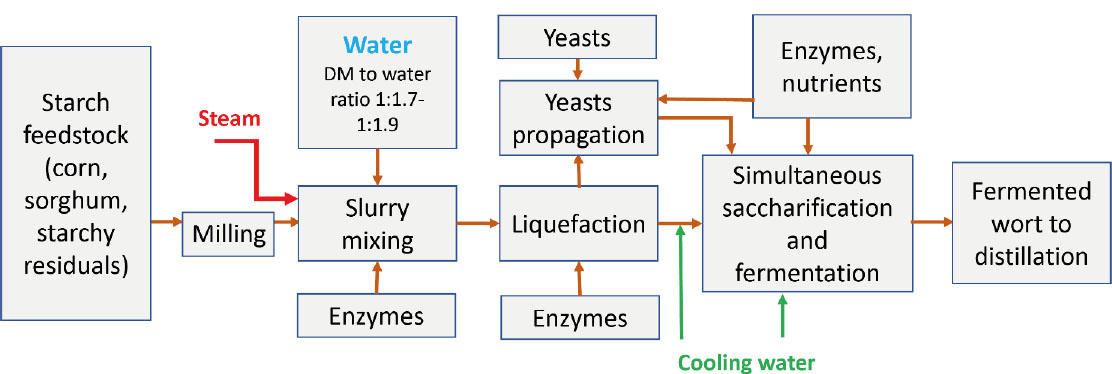
Schematic diagram of fermented wort preparation.
Starch-based feedstocks were milled and slurried with water at ratios designed to yield a final ethanol concentration in the fermented wort ranging from approximately 14% to over 17% v/v. This corresponded to a decrease in the water-to-raw-material ratio from 2.4 to 1.7, accompanied by a proportional increase in dry matter content from 27% to 34%. The resulting mash was then heated to 90–95°C, accompanied by the addition of commercial enzymes for starch hydrolysis and viscosity reduction. A commercial thermostable amylase and a thermostable cellulase complex were applied at dosages recommended by the manufacturer, adjusted relative to the dry solids content of the mash. Following a 4-hour liquefaction phase, the mash was cooled, and the enzyme blend (comprising glucoamylase, protease, and fungal α-amylase), along with essential nutrients (urea, orthophosphoric acid, and sulfuric acid), was introduced. The yeast strain, chemical reagents, and enzymes used, along with their commercial names, activities, and dosages, have been described previously [16].
Dosages were optimised based on the dry solids matrix and the feedstock-specific pH requirements. The resulting wort, adjusted to approximately pH 4.8, was transferred to batch fermenters configured for a simultaneous saccharification and fermentation (SSF) process.
For the yeast propagation phase, a portion (≈12-15%) of the prepared wort was diverted to separate propagation tanks. Industrial dry yeast (Saccharomyces cerevisiae), capable of tolerating temperatures up to 37°C and ethanol titers exceeding 20% v/v, was inoculated at the manufacturer’s recommended dosage. Following a 12–15-hour propagation cycle, the culture reached a density of 250-350x106 cells/cm3 before being transferred to the main fermenter. This pitching strategy was employed to accelerate yeast acclimatisation and minimise the lag phase. Main fermentation was carried out at 33°C for 65 to 80 hours, concluding when the residual unfermented sugar concentration dropped below 0.5 g/dm3 in compliance with the plant laboratory quality control regulations. The final calculated ethanol yield was at least 66.5 decaliters per metric ton of starch.
A major challenge in industrial implementation of VHG technology is managing the viscosity of the slurry following the milling, hydration, and thermal processing of the raw materials [16]. An increase in dynamic viscosity beyond 300 mPa·s is highly problematic, as it introduces severe operational difficulties. These include increased resistance during mash and wort pumping or agitation, reduced heat transfer efficiency within thermal exchange equipment, and mass transfer limitations between the yeast cells and the nutrient substrate during fermentation. Therefore, during the mixing stages and the thermal and enzymatic liquefaction processes of the VHG mash, it was necessary to continuously monitor the liquid's viscosity and corresponding temperature and adjust the amounts of α-amylase and other viscosity-reducing enzymes for the preparations. This was an important aspect of using the unstable composition of the raw materials entering the production. Practical technological indicators, including consumption of raw materials, water, enzymes and nutrients, wort, fermented wort, steam, ethanol, and others, were recorded using instruments of the automated process control system (APCS) integrated into the plant.
To determine the ethanol concentration, 200 mL samples of fermented wort were diluted with 100 mL of distilled water and subjected to laboratory distillation to recover exactly 200 mL of distillate. The ethanol concentration of the collected distillate was subsequently measured using a DMA 4101 digital density meter (Anton Paar, Austria). As the final distillate volume matched the initial sample volume, the measured value directly quantified the ethanol concentration in the original fermented wort.
2.2. Distillation, Rectification, and Sorption Dehydration Process
During the plant’s commissioning phase and throughout the subsequent six months of operation, the final ethanol concentration of the fermented wort entering the distillation, rectification, and sorption dehydration units was periodically monitored and recorded. Over this operational period, iterative process modifications and optimisations were introduced during wort preparation and fermentation to systematically increase the final ethanol titer from 13.5% v/v to 17.5% v/v. Simultaneously with the determination of the final ethanol content of the wort, the steam consumption per unit of product was recorded and used to calculate the specific energy consumption for dehydrated ethanol production. The schematic diagram of the unit is shown in Fig. (2).
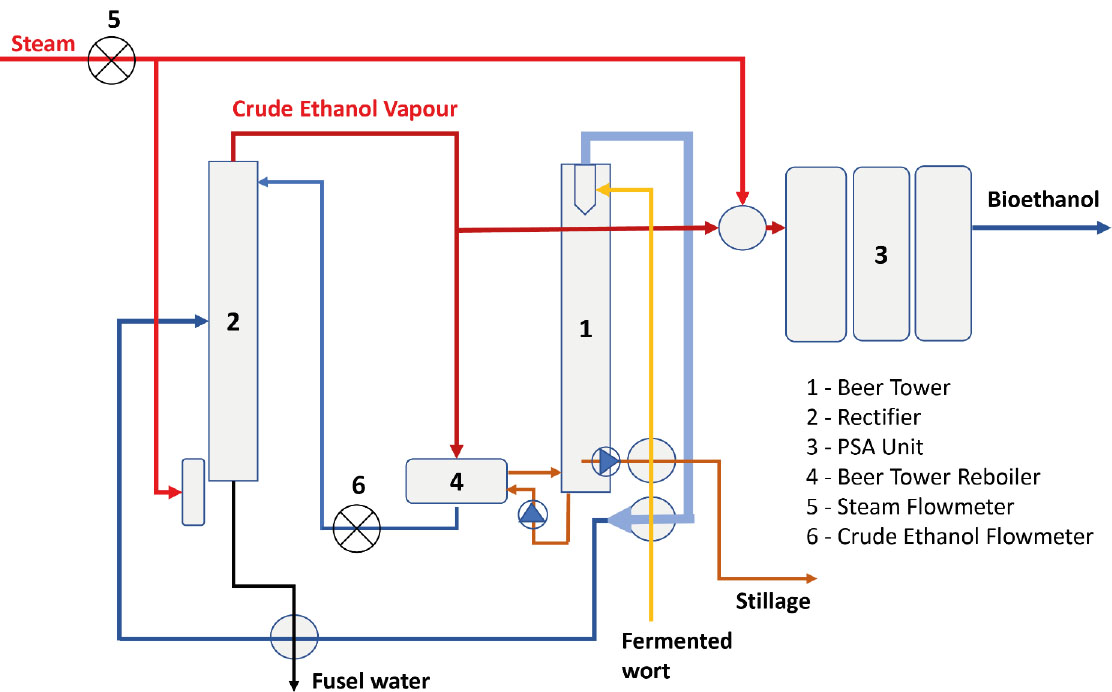
Schematic diagram of an industry-scale distillation/rectification and dehydration (Pressure Swing Adsorption - PSA) unit.
The purification system comprises a distillation (beer) column (1), a rectification column (2), and twin adsorber vessels (3) configured for the pressure swing adsorption (PSA) dehydration of crude ethanol. Bioethanol production volumes were continuously monitored using a certified custody-transfer flow meter. Simultaneously, an industrial inline flowmeter (5) recorded the total process steam mass flow rate. These data streams were utilised to quantify the specific thermal energy demand, expressed as process steam consumption per unit volume of fuel-grade ethanol, across the coupled distillation, rectification, and sorption dehydration.
Simultaneously, the flow meter (6) measured the volumetric flow rate of the raw ethanol condensate recovered from the evaporator/reboiler (4) of the distillation column. Because the overhead raw ethanol vapour stream from the distillation column acts as the primary heat transfer fluid to drive the distillation column (1) via the evaporator (4), its specific heat of vaporisation, combined with the measured mass of the resulting condensate, served as the baseline data for back-calculating the exact fraction of boiler steam consumed strictly for the distillation of the corresponding fermented wort matrix. For the thermodynamic evaluations, the specific latent heat of vaporisation (∆Hvap) was taken as 2257 kJ/kg for the boiler steam and 970 kJ/kg for the raw ethanol vapours. Consequently, these enthalpy values enabled the determination of both the total specific steam consumption, encompassing coupled distillation, rectification, and sorption dehydration, and the isolated specific steam demand allocated solely to the primary wort distillation stage, each as a function of the final ethanol concentration in the fermented broth. The calculation of the total specific steam consumption for distillation/ rectification and ethanol dehydration (St, t/m3) is as follows in Eqs. (1 and 2):
 ...(1)
where Q is total steam consumption, t/hour, and Y is bioethanol output, m3/hour.
The formula for specific steam consumption for distillation (Sd, t/m3) is as follows:
 ...(2)
where Re is the latent heat of vaporisation of ethanol, kJ/t; F is the flow of ethanol vapor condensate, t/h; Rs is the latent heat of vaporisation of water vapor, kJ/t; and Y is bioethanol yield, m3/h.
2.3. Statistical Analysis
Mean values and standard deviations were calculated using Microsoft Excel LTSC Professional Plus 2024 (Microsoft Corporation, USA). Scatter plots and exponential decay curve fitting were performed using OriginPro 2025 (OriginLab Corporation, USA). During plant commissioning, the boiler's specific steam consumption at ethanol concentrations of 14% and 17% (v/v) was calculated using the equations shown in the corresponding graphs. Confidence intervals for the fitted model parameters are 95%. The total number of experimental data points used to generate the trendlines and fit the exponential decay models was n = 30 for Figs. (3 and 4). The data collected during the period shown in Table 1 demonstrate sufficient process cycles and ensure the necessary sample representativeness for identifying patterns.
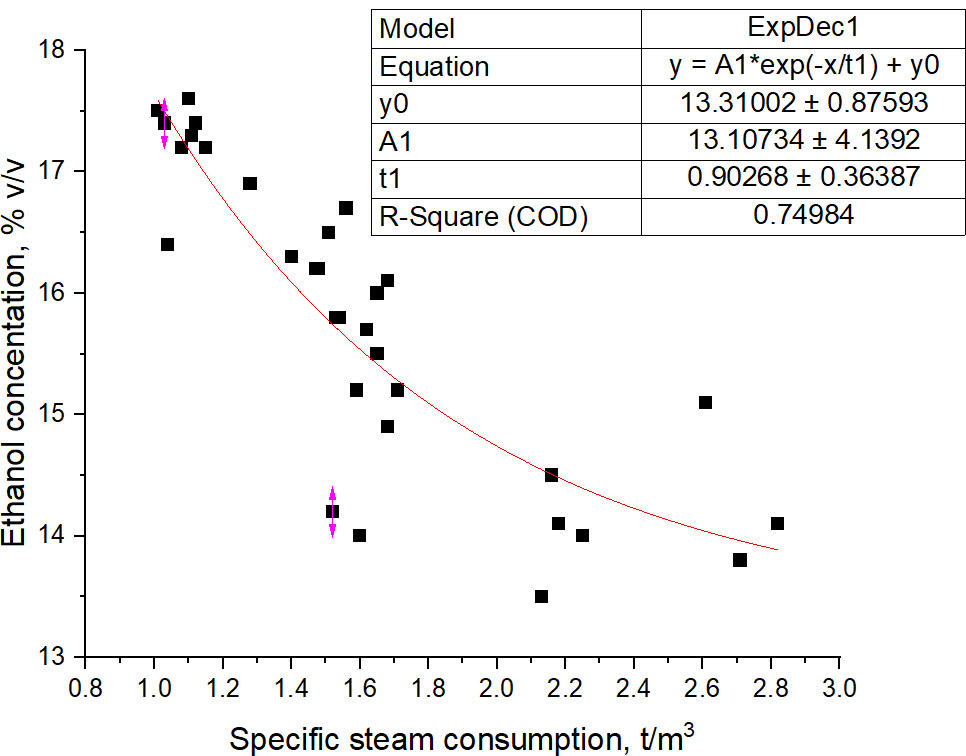
Specific boiler steam consumption for coupled distillation, rectification, and sorption dehydration as a function of final ethanol concentration in the fermented wort.
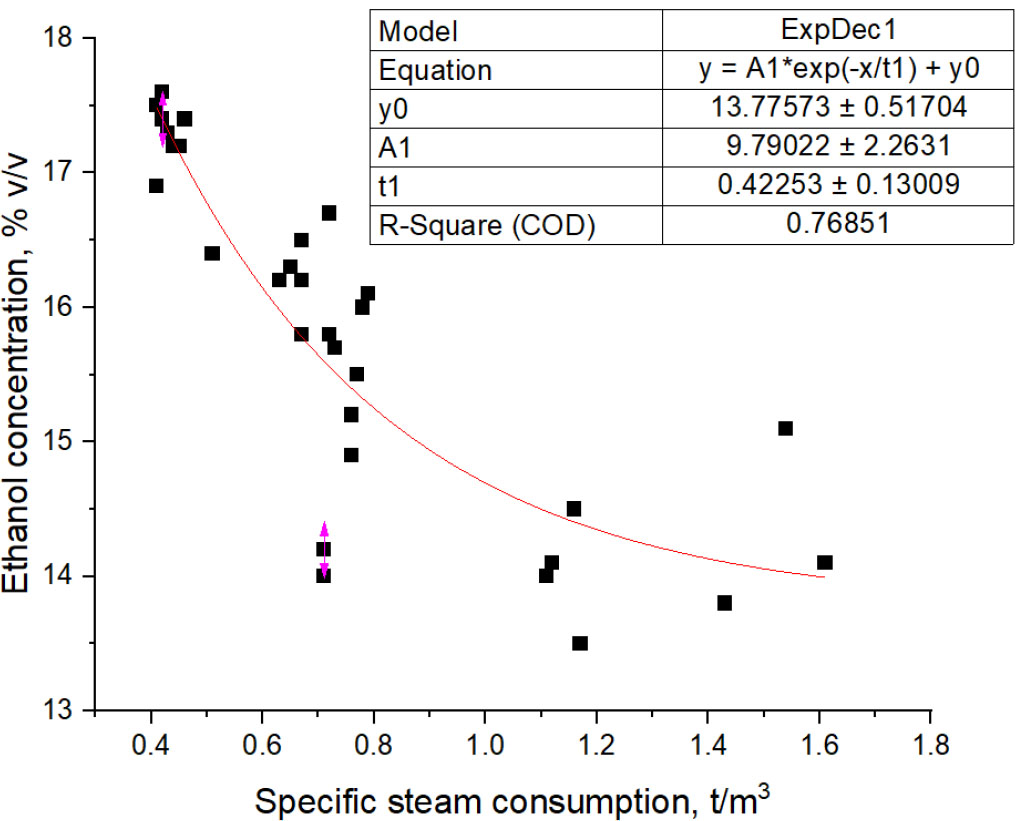
Dependence of specific boiler steam consumption for distillation on the ethanol concentration in the fermented wort.
| Period - Days | Bioethanol Production m3/day | Total Steam Consumption t/m3 | Specific Electricity Consumption - kWh/m3 |
|---|---|---|---|
| 1 | 105.10 | 1.87 | 227 |
| 2 | 116.79 | 1.76 | 222 |
| 3 | 101.97 | 1.96 | 227 |
| 4 | 118.11 | 1.73 | 202 |
| 5 | 117.90 | 1.77 | 208 |
| 6 | 116.70 | 1.77 | 202 |
| 7 | 116.53 | 1.72 | 202 |
| 8 | 116.67 | 1.78 | 210 |
| 9 | 115.99 | 1.84 | 209 |
| 10 | 116.86 | 1.71 | 207 |
| 11 | 116.37 | 1.71 | 189 |
| 12 | 116.55 | 1.84 | 215 |
| 13 | 116.75 | 1.77 | 225 |
| 14 | 116.87 | 1.79 | 208 |
| 15 | 117.08 | 1.76 | 193 |
| 16 | 117.09 | 1.77 | 213 |
| 17 | 116.54 | 1.75 | 189 |
| 18 | 116.53 | 1.77 | 192 |
| 19 | 116.73 | 1.81 | 194 |
| 20 | 116.55 | 2.03 | 213 |
| 21 | 116.65 | 1.98 | 237 |
| 22 | 116.59 | 1.97 | 225 |
| 23 | 116.79 | 1.98 | 228 |
| 24 | 122.29 | 1.95 | 209 |
| 25 | 116.96 | 1.96 | 215 |
| 26 | 116.69 | 2.02 | 229 |
| 27 | 117.12 | 1.92 | 230 |
| Mean | 116.03 | 1.84 | 211.85 |
| Standard deviation | 3.80 | 0.10 | 13.76 |
3. RESULTS
The empirical data detailing boiler steam consumption across the combined distillation, rectification, and sorption dehydration steps are presented in Fig. (3). The data points plot the calculated specific boiler steam consumption as a direct function of the ethanol concentration in the fermented wort. Correspondingly, Fig. (4) isolates the calculated boiler steam consumption specifically allocated to the primary wort distillation stage across the same concentration gradient.
Based on the trendline equation established for Fig. (3), the specific boiler steam consumption for coupled distillation, rectification, and sorption dehydration was approximately 2.66 t/m3 of bioethanol at a fermented wort concentration of 14.0% v/v. In comparison, elevating the ethanol concentration to 17.0% v/v dramatically reduced the specific steam demand to approximately 1.14 t/m3 of bioethanol.
Considering the trendline equation in Fig. (4), the specific boiler steam consumption for distillation was 1.60 t/m3 of bioethanol for fermented wort with an ethanol concentration of 14.0% v/v, compared with 0.47 t/m3 of bioethanol for an ethanol concentration of 17.0% v/v.
The mathematical approximation of the operational dataset clearly demonstrates that the specific steam consumption per unit of bioethanol produced, both during the isolated wort distillation stage and across the entire coupled distillation, rectification, and sorption dehydration train, decreases significantly as the final ethanol concentration in the fermented wort rises.
Table 1 shows the daily bioethanol productivity, the corresponding total boiler steam consumption, and the specific electricity consumption after the VHG fermentation achieved a final ethanol concentration in the fermented wort of 17.2±0.4% v/v, including steam consumption for wort preparation.
4. DISCUSSION
4.1. Reduction in Specific Energy Consumption
Increasing the final ethanol concentration in the fermented wort from 14% to 17% v/v reduced the practical specific steam consumption across the combined distillation, rectification, and sorption dehydration train by a factor of 2.3. These thermal energy savings are primarily driven by the primary distillation stage, where the specific steam demand dropped approximately 3.4-fold. Furthermore, these trends indicate that increasing the ethanol concentration in fermented wort offers a viable pathway to achieving additional reductions in specific energy consumption. This phenomenon is fundamentally governed by the highly non-linear behaviour of the ethanol–water vapour–liquid equilibrium (VLE) relationship. Because the VLE curve flattens significantly at lower ethanol concentrations, processing a feed matrix with a higher initial ethanol titer yields a disproportionately large reduction in reboiler duty. Operating at these elevated feed concentrations bypasses the thermodynamically inefficient, energy-intensive phase of vaporising large volumes of water, thereby maximising the sensible and latent heat efficiency of the column.
A comparative evaluation between the baseline process configuration and the VHG fermentation model for corn ethanol production demonstrated [17] that a 30% reduction in process water consumption within the VHG framework simultaneously enhances ethanol throughput by 15% and reduces environmental emissions by 25%. Furthermore, this optimisation minimises downstream evaporator thermal duties by 33%, showcasing a substantial increase in both resource efficiency and environmental sustainability.
Process simulation of a $200,000-ton/year cassavabased biorefinery reveals that conventional ethanol recovery relies on energy-intensive distillation and molecular sieve dehydration, consuming approximately $1.8 of steam per kg of ethanol [25]. Implementing advanced thermal integration between the column condensers and reboilers successfully reduces this specific distillation energy to ~1.3 kg/kg. However, thermal energy demand can be further minimised to ~0.94 kg/kg by deploying VHG fermentation, which elevates the final beer concentration to 19% v/v (15.4 wt%). Ultimately, the low incremental capital expenditure (CAPEX) required to adapt the plant for VHG operations is rapidly amortised by these profound utility steam savings and the associated reduction in downstream equipment sizing.
4.2. Trade-Offs in VHG Fermentation
A separate issue is the resistance of producer microorganisms to high ethanol concentrations. For example, a specially selected strain of S. cerevisiae yeast was successfully adapted in laboratory conditions to survive at 25% v/v ethanol for 2 hours [22]. However, there are currently no industrial strains with a manufacturer-declared tolerance to ethanol concentrations above 23% v/v. The resistance of producer microorganisms to survival is not in itself an indicator of their ability to ensure the declared ethanol concentration in fermented wort on an industrial scale.
There is a limit to the ethanol concentration in the fermented wort, when the total energy and material costs for increasing the viscosity of the wort and carrying out fermentation (considering the physiological capabilities of yeast) will become unacceptable. However, analysis of the obtained data showed that the upper limit of energy efficiency of VHG technology has not yet been reached. To further elevate ethanol titers in VHG media, it is critically essential to first implement targeted interventions to minimise the viscosity of process streams during both upstream mash preparation and the active simultaneous saccharification and fermentation (SSF) phase. It is necessary to select a complex of viscosity-reducing enzymes not only for the hydrolysis of the starch components of raw materials but also for other natural polysaccharides, proteins, cellulose, and hemicellulose, which also increase the viscosity of technological liquids. In the commercial production of fuel ethanol, economics dictate the utilisation of low-cost feedstocks and diverse agricultural residues. These raw materials inherently exhibit high variability in their composition, particularly in the ratios of starch to non-starch polysaccharides. Furthermore, the specific feedstock blend supplied to a facility fluctuates dynamically based on seasonal availability and market spot prices. Consequently, industrial operations require robust, ready-to-deploy process configurations for VHG mash preparation, specifically concerning targeted multi-enzyme cocktails and specialised liquefaction processing techniques to accommodate this raw material variability. This applies in particular to starch waste, whose liquefaction conditions may exhibit distinct characteristics [23, 26].
With the initiation of stable operations at the industrial-scale facility utilising VHG technology, which achieved a final ethanol concentration in the fermented wort of 17.2±0.4% v/v, the total specific boiler steam consumption was maintained at 1.84±0.10 t/m3 of bioethanol, inclusive of the steam required for wort preparation. Additionally, the average specific electricity consumption was 212 ± 14 kWh/m3 of bioethanol produced. These data encompass the segment of the technological processing line culminating in the production of dehydrated ethanol.
4.3. Stillage Utilisation Possibilities
The energy consumption for the stillage utilisation is not included in the analysis. At Ukrainian bioethanol plants, two utilisation technologies are used: the production of feed components, DDGS (Distillers Dried Grains and Solubles) or DDG (Distillers Dried Grains), and biogas fermentation of stillage (Anaerobic Digestion - AD).
In the first configuration, the whole stillage is subjected to centrifugation to yield thin stillage and wet cake. The thin stillage is then evaporated into a syrup with a dry matter (DM) concentration of approximately 30–35%, which is subsequently co-dried with the wet cake to produce distillers' dried grains with solubles (DDGS). Alternatively, distillers' dried grains (DDG) are produced by drying the wet cake alone, while the thin stillage is routed to anaerobic digestion (AD). At biorefineries equipped with integrated biogas facilities alongside feed production systems, AD processing may utilise either raw stillage or thin stillage exclusively. The operational path is determined dynamically based on fluctuating market prices for energy carriers (biogas) versus feed products. Energy requirements vary significantly depending on the utilised stillage processing pathway. When manufacturing animal feed products, evaporation of thin stillage requires substantial thermal and electrical energy, while wet cake drying is equally energy-intensive. Consequently, at this stage of the technological process, overall energy consumption is directly proportional to the volume of whole stillage discharged from the distillation and rectification unit.
Within the anaerobic digestion (AD) pathway, a reduction in stillage volume does not compromise biogas output, provided the total mass of organic matter routed to the AD facility remains constant. Concurrently, this volumetric reduction extends the hydraulic retention time (HRT) within the AD reactors. This prolonged retention period can facilitate a more thorough degradation of organic compounds, ultimately enhancing biogas yields through a higher conversion efficiency [27, 28]. Beyond the aforementioned operational benefits, VHG technology significantly reduces the volume of polluted effluent (digestate) discharged from anaerobic digestion (AD) facilities, the subsequent treatment of which is inherently energy-intensive. Overall, the development and industrial implementation of VHG technology markedly enhances the market competitiveness of biofuels while fully aligning with the core principles of sustainable development.
5. STUDY LIMITATIONS
It should be noted that the changes and deviations observed in Figs. (3 and 4), and Table 1 during certain time periods may be attributed to several limiting factors. As the fermentation and distillation processes are inherently dynamic, their performance may be influenced by various operating conditions, including the continuity of plant operation, the volume of fermented mash fed to the distillation unit over a given period, and the establishment and control of temperature profiles within the distillation columns.
Another important factor is the type of raw material and its starch content. Changes in the raw material may require adjustments to the liquefaction process, including modifications to the viscosity control strategy and enzyme dosage, to maintain stable process performance.
Due to corporate confidentiality restrictions, current data on energy consumption and mash concentration from comparable industrial facilities, particularly in Ukraine, are not publicly available.
The study doesn’t include an economic analysis despite discussing process competitiveness. Technological efforts to produce more concentrated fermented mash are justified by the resulting energy savings. Undoubtedly, achieving higher ethanol concentrations in fermented wort will require increased costs at the stage of preparing wort with an increased (over 270 g/l) dry matter content. This is due to a higher enzyme dosage for the hydrolysis of raw material components and for reduce mash viscosity, slightly higher energy costs for pumping and mixing intermediate products, and cooling fermenters.
The energy consumption for the stillage utilisation is not included in the analysis, which, in turn, could also affect the results.
CONCLUSION
Increasing the final ethanol concentration in the fermented wort from 14% v/v to 17% v/v reduces the practical specific steam consumption across the extraction unit (distillation, rectification, and sorption dehydration) by 2.3-fold. This thermal efficiency is primarily driven by the distillation stage, where steam requirements decrease approximately by 3.4-fold. Following the stabilisation of plant operations at a fermented wort ethanol concentration of 17.2±0.4% v/v, the total specific boiler steam consumption was established at 1.84±0.10 t/m3 of bioethanol, including the thermal energy required for VHG wort preparation. Concurrently, the average specific electricity consumption was maintained at 212±14 kWh/m3 of produced bioethanol.
The possibility of reducing specific energy consumption by further increasing the final ethanol concentration in fermented wort using VHG technology is demonstrated. The data obtained relate to an operating enterprise with a bioethanol production capacity of 110 m3 per day, which uses combined starch feedstocks, including dry and liquid grain processing wastes, the specific composition of which depends on logistics and current prices. To achieve higher mash concentrations, the primary focus should be on reducing the viscosity of the mash and wort. This can be accomplished by optimising enzyme dosage and composition, as well as refining the temperature and duration of the liquefaction process to maximise the hydrolysis of both starch and non-starch components in the raw materials used for production.
The obtained data can be used to compare the energy consumption of different distillation and rectification units. They may serve as a valuable basis for the design and optimization of new bioethanol production facilities.
AUTHORS’ CONTRIBUTIONS
The authors confirm their contributions to the paper as follows: Y.V.: Conceptualised the study, collected data, performed analysis, and wrote the manuscript; S.T.: Conceptualised and designed the study, and performed analysis; T.I., V.S., and Y.B.: Contributed to data interpretation, methodological validation, and manuscript review. All authors reviewed the results and approved the final version of the manuscript.
LIST OF ABBREVIATIONS
| AD | = Anaerobic Digestion |
| APCS | = Automated Process Control System |
| DDG | = Distillers Dried Grains |
| DDGS | = Distillers Dried Grains with Solubles |
| DM | = Dry matter |
| HRT | = Hydraulic Retention Time |
| PSA | = Pressure Swing Adsorption |
| RFA | = Renewable Fuel Association |
| SAF | = Sustainable aviation fuel |
| SSF | = Simultaneous Saccharification and Fermentation |
| VHG | = Very High Gravity |
AVAILABILITY OF DATA AND MATERIALS
All data generated or analyzed during this study are included in this published article.
FUNDING
The research was supported by the National Academy of Sciences of Ukraine under the research project “Development of Scientific Foundations for Fermentation of Plant Raw Materials and Their Residues for Biofuel Production” (2024–2028, State Registration No. 0124U002605).
CONFLICT OF INTEREST
The author Dr. Yaroslav Blume is the Editor-in-Chief of The Open Agriculture Journal.
ACKNOWLEDGEMENTS
The authors acknowledge the suggestions of Dr. V. Kyrylenko (Institute of Food Biotechnology and Genomics, National Academy of Sciences of Ukraine, Kyiv, Ukraine) to improve the language of the manuscript.