All published articles of this journal are available on ScienceDirect.

Volatile Organic Compounds of Endophytic Bacillus Strains from Pinus sylvestris L. Seeds: A Comparative HS-GC-MS Study Across Three Nutrient Media
 iD
Authors Info & Affiliations
Abstract
Introduction/Objective
Endophytic bacteria of coniferous seeds are promising for developing biological products that enhance tree growth and resistance without chemical agents. Scots pine productivity is declining under climate change and pathogens, yet the Volatile Organic Compound (VOC) profiles of its seed endophytes remain poorly characterised. The objective was to compare the VOC profiles of endophytic Bacillus pumilus E11 and B. amyloliquefaciens E12 from Pinus sylvestris L. seeds in three media differing in carbon source.
Methods
VOCs in cell-free culture fluids were analysed by Headspace Gas Chromatography with Mass-Spectrometric Detection (HS-GC-MS) on a DB-624 column. Strains were grown in Potato Dextrose Broth and two synthetic media with glucose or sucrose (5 g/L) as the sole carbon source. Each strain-medium combination and its uninoculated blank were analysed in triplicate (n = 3); compounds were identified by NIST matching with retention indices and quantified semi-quantitatively (ppm).
Results
Eighteen VOCs were detected. In synthetic media, the main metabolite of B. amyloliquefaciens E12 was acetoin (81.5 ppm on glucose vs. 130.8 ppm on sucrose; +60%, p < 0.05). Branched short-chain fatty acids occurred only in E12 on glucose, while tetrahydrofuran (0.9-8.8 ppm) was a strain-specific marker of B. pumilus E11.
Discussion
The carbon-source-dependent shift in the VOC profile reflects metabolic variability of the isolates. As the study was semi-quantitative and no antifungal or in planta assays were performed, functional roles attributed to individual compounds rest on literature and require experimental validation.
Conclusion
The two endophytic Bacillus strains show distinct, medium-dependent VOC profiles. B. amyloliquefaciens E12 is a candidate for further study as a producer of growth-associated and potentially protective volatiles, pending biological validation.
1. INTRODUCTION
Endophytic bacteria are microorganisms that colonise the internal tissues of plants without causing visible signs of disease and form a wide range of symbiotic relationships with the host plant, from mutualism to commensalism [1, 2]. Seed endophytes play a special role in maintaining plant growth and development: they are present at the pre-sowing stage, protect the plant during germination and early stages of seedling development, and are transmitted vertically with seeds from generation to generation [2]. As a result, seed endophytes can act as a primary source of microbiome for the next generation of plants and form a long-term symbiosis with the host plant.
Among all the diversity of endophytic microorganisms, a special place is occupied by representatives of the genus Bacillus, which combine the ability to form stable endospores, a wide range of antimicrobial metabolites (volatile organic compounds, lipopeptides, etc.), and effective mechanisms of Plant Growth-Promoting (PGP) – production of phytohormones (auxins, cytokinins, gibberellins, etc.), phosphate solubilisation, and atmospheric nitrogen fixation [3]. Scientists have determined that the endophytic strain of Bacillus subtilis KRS015, isolated from cottonseeds, reduced plant wilt caused by the phytopathogen Verticillium dahliae by 61.97% due to the production of volatile organic compounds and showed a significant growth stimulation effect on cotton plants [4].
In previous studies [5], it was shown that the endophytic microbiota of Scots pine (Pinus sylvestris L.) seeds is represented mainly by B. amyloliquefaciens (80% of isolates) and B. pumilus (20% of isolates). The studied endophytic bacterial strains E11 (B. pumilus) and E12 (B. amyloliquefaciens) showed pronounced antagonistic activity against a wide range of phytopathogenic bacteria and micromycetes [5]. However, the metabolic profiles of these studied strains, in particular the composition of volatile organic compounds, remain insufficiently characterised.
Volatile Organic Compounds (VOCs) are low-molecular-weight, lipophilic substances with a molecular weight of less than 300 Da that can spread through soil pores and the air without direct contact between organisms. The chemical nature of Bacterial Volatile Organic Compounds (BVOCs) is extremely diverse, including alcohols, ketones, aldehydes, carboxylic acids, esters, and aromatic and heterocyclic compounds. A single microbial strain can produce dozens of different BVOCs, the composition of which depends significantly on the species, cultivation conditions, and substrate availability [6, 7].
A significant contribution to the formation of the modern vision of the functional role of BVOCs was made by scientists with studies [8, 9], which experimentally proved that acetoin (3-hydroxy-2-butanone) and 2,3-butanediol synthesised by B. subtilis GB03 and B. amyloliquefaciens IN937a strains significantly increase the biomass of Arabidopsis thaliana and induce systemic resistance against the bacterial pathogen Erwinia carotovora subsp. carotovora. Acetoin and 2,3-butanediol are considered molecular markers of the growth-stimulating activity of Bacillus bacteria, and the study of their production under different cultivation conditions is an important tool for biotechnological screening of endophytic strains [7, 10].
Endophytic bacteria of the genus Bacillus are effective producers of protective BVOCs, forming various phytoprotective volatile compounds [11]. The antimicrobial effect of Bacillus VOCs is realised through the disintegration of pathogen cell membranes, the inhibition of nucleic acid synthesis, and the direct inhibition of cellular respiration [12]. Many studies have shown that BVOC pyrazines, whose synthesis in Bacillus is activated in nutrient media with the addition of amino acids, exhibit broad antimicrobial and antifungal activity [13, 14].
Important for understanding the metabolism of BVOCs is the influence of the composition of the culture medium: the nature of the carbon or nitrogen source. In carbon-enriched media, the diacetyl metabolic pathway is activated: excess pyruvate produced by intensive glycolysis is converted to acetoin and 2,3-butanediol. This ensures the regeneration of NAD+ and prevents intracellular acidification, which would inhibit bacterial growth [15]. In amino acid-enriched media, amino acid catabolism predominates with the synthesis of nitrogen-containing heterocycles (pyrazines) and aldehyde precursors of auxins [13]. This metabolic variability opens up broad possibilities for regulating the composition of BVOCs in biotechnological processes.
Despite significant progress in the study of BVOCs of rhizosphere and soil isolates, the metabolic profiles of endophytic strains of Bacillus spp. from coniferous seeds have been studied very little. Scots pine (Pinus sylvestris L.) is an important forest-forming species in the temperate climate zone of Eurasia, whose productivity and sustainability are significantly reduced under the influence of climate change, moisture deficits and phytopathogens. These factors necessitate the development of environmentally friendly biotechnological means to increase the growth and resistance of conifers based on endophytic bacteria from their seeds.
Insufficient systematisation of data on the influence of the nature and chemical properties of the carbon source on the metabolic profile of Bacillus endophytes forms a distinct topical research area. For example, glucose, as a reducing monosaccharide, is highly reactive and participates in redox reactions, while sucrose is a non-reducing disaccharide with low chemical activity, in which the release of monosaccharides occurs gradually through enzymatic hydrolysis, which ensures more uniform and prolonged availability of the carbon source. It is also important to take into account that with the same amount of glucose and sucrose in the nutrient medium, the total carbon content will be slightly higher in the case of sucrose, due to its molecular structure and the ratio of atoms in the disaccharide [15]. No systematic studies of the impact of these differences on VOC production by conifer endophytes have been conducted so far. Thus, the specific gap addressed here is the absence of a direct, side-by-side comparison of the VOC profiles of seed-borne endophytic Bacillus strains from P. sylvestris under defined carbon regimes. We hypothesised that the identity and chemical nature of the carbon source (a rapidly metabolised reducing monosaccharide versus a gradually hydrolysed non-reducing disaccharide) would measurably reshape the VOC profile of these strains, and in particular shift the balance of the acetoin-butanediol pathway, and that the two species would differ in their strain-specific markers.
The aim of this study was to compare the profile of volatile organic compounds of endophytic strains of B. pumilus E11 and B. amyloliquefaciens E12 isolated from P. sylvestris L. seeds when cultivated in Potato Dextrose Broth and two synthetic mineral media with glucose (5 g/L) or sucrose (5 g/L) by means of Headspace Gas Chromatography with Mass Spectrometric Detection (HS-GC-MS). To achieve this goal, we focused on the identification of the VOCs produced by the studied endophytic bacteria in the mentioned nutrient media, on performing semi-quantitative determination of the main metabolites and comparing their content between strains and cultivation conditions; on evaluation of the influence of the nature and chemical properties of the carbon source (glucose versus sucrose) on acetoin production and overall metabolic profile; and on characterisation of the identified VOCs as potential growth-promoting and protective agents for P. sylvestris L.
2. MATERIALS AND METHODS
2.1. Endophytic Bacteria Bacillus spp. Isolated from Seeds of Pinus sylvestris L.
Two endophytic bacterial strains isolated from the seeds of Scots pine (Pinus sylvestris L.) collected in the Fastiv district of the Kyiv region (Ukraine) were used in the study. In our previous report [5], the isolates studied were identified using MALDI-TOF mass spectrometry and characterised by morphological, physiological, and biochemical characteristics: strain E11 – Bacillus pumilus, strain E12 – Bacillus amyloliquefaciens.
The endophytic isolates of B. pumilus E11 and B. amyloliquefaciens E12 are stored in the collection of the Department of Phytopathogenic Bacteria of the D.K. Zabolotny Institute of Microbiology and Virology of the National Academy of Sciences of Ukraine.
2.2. Nutrient Media and Cultivation Conditions
Endophytic bacteria were cultivated on three nutrient media differing in nature and chemical characteristics of the carbon source: (i) Potato Dextrose Broth is a natural medium prepared according to a standard method from potato extract [16]; (ii) Synthetic medium with glucose - mineral medium with glucose (5.0 g/L) as the only carbon source (about 2.0 g C); (iii) Synthetic medium with sucrose - modified mineral medium with sucrose (5.0 g/L) as the only carbon source (about 2.1 g C). More detailed composition of the nutrient media is given in Table 1. The initial pH of all nutrient media was adjusted to 7.0 ± 0.1.
| Component | Nutrient Medium | ||
|---|---|---|---|
| Potato Dextrose Broth | Synthetic Medium with Glucose | Synthetic Medium with Sucrose | |
| K2HPO4, g/L | N/A | 1.0 | 1.0 |
| (NH4)2HPO4, g/L | N/A | 1.0 | 1.0 |
| MgSO4, g/L | N/A | 5.0 | 5.0 |
| CaCl2, g/L | N/A | 0.1 | 0.1 |
| Glucose, g/L | N/A | 5.0 | N/A |
| Sucrose, g/L | N/A | N/A | 5.0 |
| NaCl, g/L | 5.0 | N/A | N/A |
| Potato broth | Standard preparation* | N/A | N/A |
All reagents used in this study were of analytical grade. The mineral medium salts (K2HPO4, (NH4)2HPO4, MgSO4, CaCl2), the carbon sources (glucose and sucrose), and sodium chloride (NaCl), including the NaCl used for the salting-out step, were of chemically pure grade (purity > 99%; manufactured by Sigma-Aldrich) and were supplied by Chemlaborreactiv LLC (Brovary, Kyiv region, Ukraine). The helium used as the carrier gas was of high-purity chromatographic grade (approximately 99.999% purity, essentially free of impurities), supplied by Linde (Linde Ukraine). The potato extract for Potato Dextrose Broth and the bacterial strains were obtained as described in Sections 2.1-2.2.
The endophytic bacteria were cultivated at 27-28°C for 48 hours at 240 rpm under aerobic conditions. The inoculum was prepared from the culture by standardising it to an optical density (OD600) of 0.1 (corresponding to about 108 CFU/mL), and then added to the culture medium at a 1:100 (v/v) ratio.
2.3. Sample Preparation for HS-GC-MS Analysis
After cultivation, the bacterial suspensions were centrifuged at 5000 rpm for 10 minutes to separate the cell mass. The resulting cell-free supernatant (culture fluid) was used as the test sample. To exclude the influence of the solvent signal on the analysis results, control samples were prepared in parallel, which were sterile culture media without inoculation, identical in composition to the test samples.
The static headspace sampling method was chosen for its advantages for the analysis of volatile hydrophilic metabolites in liquid culture fluids: minimisation of matrix effects, reproducibility of thermodynamic equilibrium between the liquid and gas phases, and compatibility with automated analysis [17].
Samples for vapour phase analysis were prepared according to a standardised procedure. A 20 mL headspace vial was filled with 2.0 mL of the cell-free supernatant under study, and 0.6 g of crystalline NaCl was added to create a salting effect, which increased the distribution coefficient of analytes between the liquid and gas phases due to a decrease in water activity and an increase in hydrophobic interactions. The vials were hermetically sealed with aluminium caps with Teflon septa to ensure gas-phase equilibrium. Prior to injection into the chromatography system, the samples were thermostated and stirred for 5 minutes at 25°C to homogenise the liquid phase and stabilise the analysis conditions. Each medium inoculated with the test strain and control samples was analysed in triplicate (n = 3).
2.4. Analysis of Volatile Organic Compounds by HS-GC-MS
The identification and semi-quantitative determination of VOCs in culture fluids were carried out using Headspace Gas Chromatography with Mass Spectrometric Detection (HS-GC-MS). This method is used to determine the profile of volatile metabolites in bacterial culture fluids and is a standardised tool for the detection of VOCs produced by microorganisms [17], in particular those of the genus Bacillus [18].
The analysis was performed on an Agilent Technologies 6890N chromatography system with an Agilent Technologies 5975 MSD mass spectrometry detector (Agilent Technologies, USA) using ChemStation software (Agilent Technologies). The samples were analysed in full ion scan mode with automatic injection of the vapour phase through an autosampler. The parameters of the chromatographic system and HS-GC-MS analysis are shown in Table 2.
| Parameter | Value |
|---|---|
| System | Agilent Technologies 6890N / MSD Agilent Technologies 5975 |
| Chromatographic column | DB-624 capillary column, 30 × 0.25 mm, coated with a 1.4 µm layer of 6% cyanopropyl/phenyl and 94% polydimethylsiloxane |
| Thermostatting temperature of the headspace vial | 80°C |
| Thermostatting time of the headspace vial | 40 min |
| Loop temperature | 90°C |
| Transfer line temperature | 100°C |
| Volume of vapour phase injection | 1.0 mL |
| Column temperature programme | 40 °C (3 min) → 4 °C/min → 100 °C (3 min) → 8 °C/min → 200 °C (3 min) → 20 °C/min → 240 °C (4 min) |
| Carrier gas | Helium for chromatography |
| Carrier gas flow rate | 1.0 mL/min |
| Flow rate split | 1:5 |
| Injector temperature | 200°C |
| Ion source temperature | 230°C |
| Ionisation energy | 70 eV |
| Scanning range | 29-500 m/z |
The detected VOCs were identified by comparing the experimental mass spectra with the NIST/EPA/NIH Mass Spectral Library (NIST version 23) using ChemStation software (Agilent Technologies). The reliability of the identification was confirmed by the value of the mass spectra similarity coefficient, Match Factor (MF) – it should be at least 80%, which corresponds to the generally accepted criterion for the study of volatile compounds by GC-MS [17, 18].
2.4.1. Method Validation and Quality Control
Compound identification by mass-spectral library matching was supported by linear Retention Indices (RI) calculated from a C7-C30 n-alkane series analysed under identical chromatographic conditions; experimental RI values were compared with reference values from the NIST database, and assignments were accepted only when the MF was ≥ 80%, and the RI deviation was within ± 20 units. To control for background and carry-over, uninoculated sterile medium of identical composition was analysed as a blank in parallel with every batch, and peaks present in the blanks were subtracted before further evaluation; compounds attributable to the medium or to the analytical system were excluded. Because the study was designed as a comparative, semi-quantitative screening based on internal normalisation of the Total Ionic Current (TIC) peak areas, absolute quantification with authentic external standards, formal Limits of Detection (LOD) and Quantification (LOQ), and an internal standard were not applied; the reported ppm values should therefore be interpreted as relative, not absolute, concentrations. This is addressed further in the Study Limitations section.
Semi-quantitative determination of VOC concentra-tions was performed using internal normalisation with the areas of chromatographic peaks calculated via Chem-Station software. The concentrations were expressed in ppm (mg/L) relative to the TIC.
2.5. Statistical Processing of Results
Each test and control sample was analysed in triplicate (n = 3). The triplicates represent analytical (measurement) replicates of independently prepared culture fluids for each strain-medium combination. Before parametric testing, the normality of the data was checked with the Shapiro-Wilk test and the homogeneity of variances with Levene’s test. Pairwise comparisons between two conditions were made with Student’s t-test, and comparisons across more than two conditions with one-way ANOVA followed by Tukey’s HSD post-hoc test; to limit the family-wise error rate in multiple comparisons, p-values were adjusted using the Benjamini-Hochberg procedure (for the pairwise t-tests) and Tukey’s HSD, which controls the family-wise error rate, for the ANOVA comparisons. Differences were considered significant at p < 0.05. The use of three replicates (n = 3) is a recognised constraint for a semi-quantitative screening study; it provides a minimum basis for parametric comparison but limits statistical power, and this is acknowledged in the Study Limitations section. Where relevant, the magnitude of differences is reported alongside p-values as the mean difference and its relative change (e.g. the +60% increase in acetoin), so that effect size, and not only statistical significance, can be judged. Numerical results are presented as the arithmetic Mean (M) ± Standard Deviation (SD). Statistical processing of the experimental data and construction of summary tables were performed using the Statistica 6.0 software package (StatSoft Inc., USA) and the built-in statistical functions of Microsoft Excel 2016. Chromatographic data processing, peak integration, and comparison of mass spectra with library standards were performed using Agilent ChemStation software.
3. RESULTS AND DISCUSSION
3.1. General Characterisation of Volatile Organic Compounds of B. pumilus E11 and B. amyloliquefaciens E12
Preliminary analysis of metabolic activity revealed that B. amyloliquefaciens E12 exhibited higher levels of metabolite production compared with B. pumilus E11. Consequently, to characterise the profile of VOCs in greater detail, further studies on a synthetic glucose-containing medium were performed only for B. amyloliquefaciens E12.
All profiles reported below were obtained after subtraction of peaks detected in the corresponding uninoculated-medium blanks, so that the listed compounds represent metabolites of bacterial origin rather than constituents or artefacts of the culture medium. Only two isolates were examined because they were the dominant culturable endophytes recovered from P. sylvestris seeds in our previous work; this restricts the taxonomic breadth of the study, as noted in the Study Limitations section.
In the culture liquids of endophytic bacteria B. pumilus E11 and B. amyloliquefaciens E12 isolated from Pinus sylvestris L. seeds, 18 VOCs belonging to different chemical classes were determined and identified by the method of headspace gas chromatography with mass spectrometric detection: alcohols, aliphatic ketones, carboxylic acids, aromatic hydrocarbons, heterocyclic compounds, and esters. A summary table of detected VOCs with their quantitative content is presented in Table 3.
| VOC | Nutrient Medium | ||||
|---|---|---|---|---|---|
| Synthetic Medium with Glucose | Synthetic Medium with Sucrose | Potato Dextrose Broth | |||
| Endophytic Isolate, ppm | |||||
| B. Amyloliquefaciens E12 | B. Amyloliquefaciens E12 | B. Pumilus E11 | B. Amyloliquefaciens E12 | B. Pumilus E11 | |
| Acetone | N/D | N/D | N/D | 1.6 ± 0.1 | N/D |
| Vinyl acetate | 1.2 ± 0.2 | N/D | N/D | 2.0 ± 0.1 | N/D |
| Acetoin | 81.5 ± 1.1 | 130.8 ± 1.3 | 14.6 ± 0.5 | N/D | N/D |
| 2,3-Butandione | 1.3 ± 0.3 | 3.5 ± 0.4 | N/D | 2.1 ± 0.2 | 0.7 ± 0.2 |
| 2,3-Butanediol | 0.9 ± 0.1 | 2.9 ± 0.2 | 3.0 ± 0.1 | N/D | N/D |
| Tetrahydrofuran | N/D | N/D | 8.8 ± 0.5 | N/D | 0.9 ± 0.1 |
| Benzaldehyde | N/D | N/D | N/D | 0.5 ± 0.1 | 0.3 ± 0.1 |
| Pyrazine | 0.4 ± 0.1 | N/D | N/D | N/D | N/D |
| 2-Methylpyrazine | 1.2 ± 0.1 | N/D | N/D | N/D | N/D |
| 2-Methyl-3-pentanol | 1.3 ± 0.3 | 1.1 ± 0.2 | N/D | N/D | N/D |
| Isobutyric acid | 1.3 ± 0.2 | N/D | N/D | N/D | N/D |
| Isovaleric acid | 1.0 ± 0.2 | N/D | N/D | N/D | N/D |
| 2-Methylbutanoic acid | 0.9 ± 0.1 | N/D | N/D | N/D | N/D |
| 5-Hydroxy-4-octanone | 0.4 ± 0.1 | N/D | N/D | N/D | N/D |
| Dihydro-2-methyl-3(2H)-thiophenone | N/D | N/D | 0.3 ± 0.1 | N/D | N/D |
| 1,2,3-Trimethylbenzene | N/D | N/D | 0.4 ± 0.1 | N/D | N/D |
| 1,3,4-Trimethylbenzene | N/D | N/D | 0.4 ± 0.2 | N/D | N/D |
| Cumene | N/D | N/D | 0.3 ± 0.1 | N/D | N/D |
The results of the analysis showed that the qualitative and quantitative profile of metabolites varies depending on the strain of endophytes and the composition of the nutrient medium, which indicates specific features of the metabolic variability of the studied isolates and is consistent with the literature data on other endophytic bacteria of the genus Bacillus [18, 19].
It was determined that the endophytic bacterium B. amyloliquefaciens E12 showed significantly higher metabolic activity in synthetic media than in Potato Dextrose Broth: up to 11 VOCs were identified in mineral media, whereas only 5 metabolites were detected at low concentrations (0.3-2.1 ppm) in Potato Dextrose Broth. A different metabolic profile was found for B. pumilus E11, but, in accordance with B. amyloliquefaciens E12, more intensive VOC production was detected in the synthetic medium compared to Potato Dextrose Broth.
3.2. Acetoin is the Main Marker of PGP Activity
Acetoin (3-hydroxy-2-butanone) is an important physiological metabolite produced and released by various microorganisms during growth on glucose and other fermentable carbon sources. The multifunctional role of acetoin in the bacterial cell includes preventing excessive acidification of the environment during intensive glycolysis, regulating the intracellular NAD+/NADH ratio, and accumulating carbon as a reserve metabolite. The ability of microorganisms to produce acetoin, which is detected by the Voges-Proskauer reaction, is used as a taxonomic marker for the identification of Bacillus bacteria [15]. Acetoin and its reduction product (2,3-butanediol) are key signalling molecules in the interaction between Plant Growth-Promoting Bacteria (PGPB) and the host plant, capable of activating Induced Systemic Resistance (ISR) and stimulating plant growth at low concentrations [8, 10]. The results of determining the acetoin content in the culture fluids of the studied strains under different cultivation conditions are shown in Fig. (1).
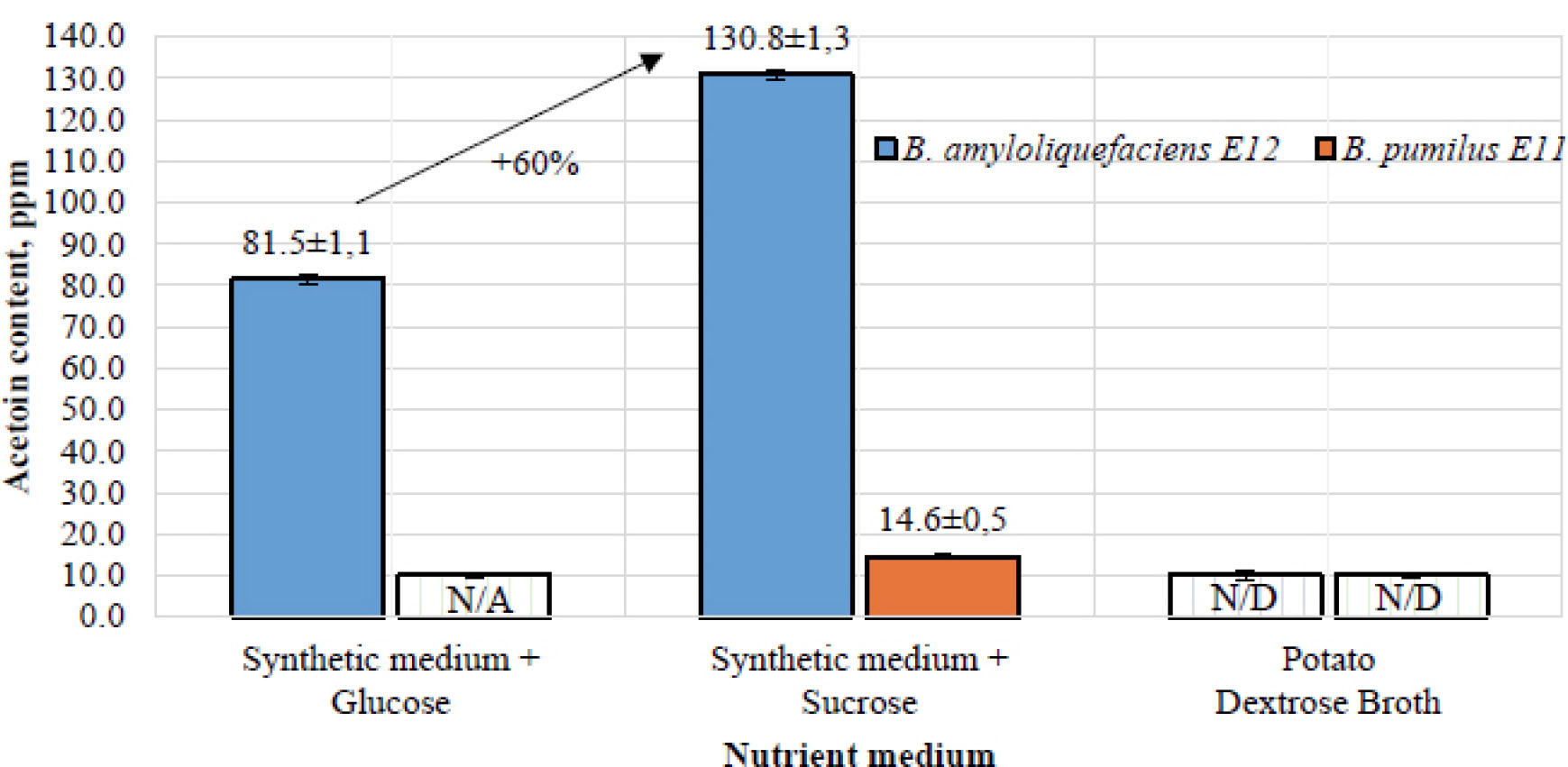
Comparison of acetoin content in the culture fluids of B. amyloliquefaciens E12 and B. pumilus E11 depending on the composition of the nutrient medium (n = 3; M ± SD, ppm). Note: N/A – Not Applicable (no study was performed); N/D – Not Detected (below the detection threshold).
Analysing the results of the study presented in Table 3, it was determined that acetoin is the predominant metabolite in the VOCs profile of B. amyloliquefaciens E12 in synthetic media. In the medium with glucose as a carbon source, the acetoin content was 81.5 ± 1.1 ppm, and in the synthetic medium with sucrose, 130.8 ± 1.3 ppm, which corresponds to an increase of about 60% (p < 0.05, Student's t-test). In the culture fluid of B. pumilus E11, acetoin with a concentration of 14.6 ± 0.5 ppm was detected only in the sucrose medium, which is almost 9 times lower than in B. amyloliquefaciens E12 under the corresponding conditions (p < 0.01, one-way ANOVA, Tukey's post-hoc test). For the studied strains of endophytic bacteria, acetoin was not detected in Potato Dextrose Broth (below the detection threshold).
Acetoin biosynthesis in Bacillus spp. occurs via a two-step pathway that is an offshoot of glycolysis at the pyruvate level: Acetolactate Synthase (ALS, encoded by the alsS gene) converts two pyruvate molecules to α-acetolactate with the release of CO2, and Acetolactate Decarboxylase (ALDC, encoded by the alsD gene) catalyses the non-oxidative decarboxylation of α-acetolactate to acetoin [8, 15, 20]. A schematic diagram of the metabolic pathway for the synthesis of acetoin and 2,3-butanediol from glucose is shown in Fig. (2).
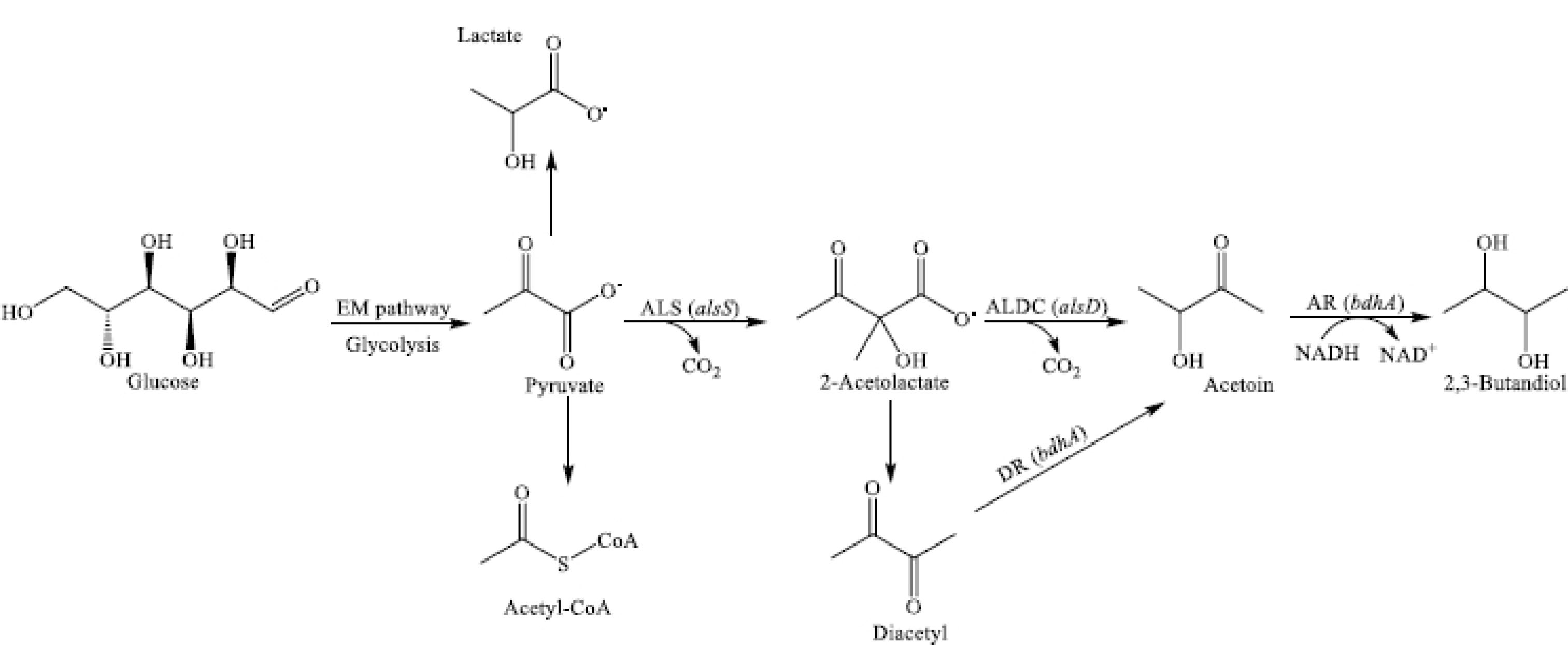
Metabolic pathways for the synthesis of acetoin and 2,3-butanediol from glucose in Bacillus species. Note: ALS – acetolactate synthase; ALDC – acetolactate decarboxylase; DR – diacetyl reductase; AR – acetoin reductase.
Further reduction of acetoin by acetoin reductase (AR, encoded by the bdhA gene) leads to the formation of 2,3-butanediol, determined in amounts of 0.9-2.9 ppm for B. amyloliquefaciens E12 in the two synthetic media studied and 3.0 ppm for B. pumilus E11 only in sucrose medium (Table 3). The processes associated with the activation of growth-promoting effects and the induction of systemic plant protection resistance through the acetoin-2,3-butanediol metabolic pathway in Bacillus bacteria are well studied in modern phytobiotechnology research [7-10, 15].
The results of the study for B. amyloliquefaciens E12 are consistent with the physiological and metabolic characteristics of B. amyloliquefaciens as a natural acetoin producer. Researchers [21] determined that B. amyloliquefaciens FMME044 could produce acetoin in industrial concentrations (51.2 g/L) when cultivated in a nutrient medium with added glucose. Scientists [21] also revealed specific characteristics of the enzyme activity: 2,3-butanediol was reversibly converted to acetoin after the substrate (glucose) was depleted; low stirring speed promoted the accumulation of 2,3-butanediol; and high stirring speed promoted the reverse conversion of 2,3-butanediol to acetoin. Analysing these factors, it is possible to justify the relatively low concentrations of 2,3-butanediol compared to acetoin in the studied samples of B. amyloliquefaciens E12 by the long cultivation time of endophytic bacteria (48 hours).
The recorded increase in acetoin production by the endophytic isolate B. amyloliquefaciens E12 when changing the nutrient synthetic medium from glucose to sucrose (81.4→130.3 ppm; +60%) requires further substantiation. Glucose is a reducing monosaccharide with a free C1-anomeric hydroxyl group that undergoes glycolysis without prior enzymatic transformations, which provides an intense initial flux of pyruvate into cellular metabolism. However, the high chemical reactivity of glucose and its rapid utilisation can lead to a less stable supply of carbon to cell metabolism. Sucrose (β-D-fructofuranosyl-α-D-glucopyranoside) is a non-reducing disaccharide in which anomeric carbon atoms (C1 of glucose and C2 of fructose) form a glycosidic bond that prevents oxidation and opening of the cyclic form of the compound. The enzymatic hydrolysis of sucrose to glucose and fructose leads to a gradual release of monosaccharides, providing a more even and prolonged supply of carbon to the glycolytic pathway. The mass fraction of carbon in sucrose (about 42%) is higher than that of glucose (about 40%), so at the same substrate concentration in the culture medium, a slightly higher amount of carbon is supplied when using sucrose. However, maintaining a stable supply of carbon through glycolysis and the tricarboxylic acid cycle contributes to the accumulation of pyruvate, which can be redistributed through the ALS/ALDC pathway towards acetoin biosynthesis [15, 22], which correlates with increased acetoin production by B. amyloliquefaciens E12 bacteria in a synthetic medium with sucrose.
2,3-Butanedione (diacetyl) was detected in all cultivation variants of the studied endophytic isolates, except for B. pumilus E11 in sucrose medium (Table 3). The maximum content of diacetyl was determined for B. amyloliquefaciens E12 in synthetic sucrose medium (3.5 ppm) and in Potato Dextrose Broth (2.0 ppm). Diacetyl is a by-product of the ALS reaction in the absence of ALDC activity, which is a marker of excess α-acetolactate [15, 20]. The higher level of diacetyl in B. amyloliquefaciens E12 correlates with higher acetoin content, which confirms the activity of the ALS pathway in this strain regardless of the nature of the carbon substrate. Together with 2,3-butanediol (0.9-2.9 ppm for B. amyloliquefaciens E12, 3.0 ppm for B. pumilus E11), acetoin and diacetyl form a functionally related “C4-metabolic complex”, the physiological function of which is to regulate the intracellular redox balance (NAD+/NADH) and prevent cytoplasmic acidification [8, 15].
The absence of acetoin in the studied strains in Potato Dextrose Broth can be explained by the composition of the nutrient medium: potato broth contains a significant amount of amino acids, peptides, and carbohydrates of different nature, which can lead to a redistribution of carbon from ALS/ALDC reactions to amino acid catabolism and subsequent inhibition of the acetoin pathway [7, 15].
3.3. Branched Short-chain Fatty Acids are Specific Fungistatic Metabolites of B. amyloliquefaciens E12
The analysis of the data in Table 3 indicates the presence of B. amyloliquefaciens E12 in synthetic glucose medium, a complex of branched Short-Chain Fatty Acids (SCFAs) specific to this study: isobutyric (2-methylpropanoic) acid (1.3 ppm), isovaleric (3-methylbutanoic) acid (1.0 ppm), and 2-methylbutanoic acid (0.9 ppm). None of these compounds were detected in B. amyloliquefaciens E12 and B. pumilus E11 on sucrose medium and in Potato Dextrose Broth.
The branched SCFAs of the endophytic bacterium B. amyloliquefaciens E12 are of considerable interest as fungistatic agents (a role reported in the literature for related strains but not tested experimentally in the present study). Researchers [23] found that isovaleric acid, which is found in the volatile metabolites of Bacillus velezensis CE 100, inhibits spore germination and micellar growth of Colletotrichum gloeosporioides. A study [24] found that 2-methylbutanoic acid in combination with isobutyric and isovaleric acids are the main component of the antifungal VOCs profile of Bacillus tequilensis XK29, which showed effective inhibitory activity against Ceratocystis fimbriata. Researchers [25] identified isobutyric acid as the primary fungistatic agent in the VOC profile of Bacillus velezensis SEC-024A, with an EC50 (half-maximum effective concentration) of 0.012 μl/mL against Agroathelia rolfsii.
The specific production of branched SCFAs exclusively in glucose medium is an important factor for understanding the regulation of B. amyloliquefaciens E12. The absence of short-chain fatty acids in the synthetic medium with sucrose may indicate competitive carbon allocation: with a slower supply of monosaccharides (due to sucrose hydrolysis), carbon metabolism is directed toward intensive acetoin biosynthesis via the ALS/ALDC pathway. Moreover, under conditions of high glucose consumption, the catabolism of branched-chain amino acids can be stimulated with the subsequent production of branched-chain SCFAs.
3.4. Tetrahydrofuran as a Strain-specific Marker of B. pumilus E11
Tetrahydrofuran is an aliphatic five-membered cyclic ether that was detected only in the culture fluids of B. pumilus E11 (as indicated in Table 3): in synthetic sucrose medium at 8.8 ppm and in Potato Dextrose Broth at 0.9 ppm. No Tetrahydrofuran (THF) was detected in the samples of B. amyloliquefaciens E12. Therefore, THF is a specific marker metabolite of B. pumilus E11 and can be used as a differential analytical feature in the identification of this strain in complex microbial associations. A similar strain-specific presence of certain esters in the VOC profile for Bacillus spp. has also been reported in other studies [18].
Tetrahydrofuran can be produced in bacterial cells through two mechanisms: oxidative degradation of γ-butyrolactone and its derivatives, or by cyclisation of 1,4-butanediol with the participation of specific oxidoreductases that catalyse dehydration to form a five-membered ring. Researchers [26] found that prolonged exposure to 10 mM THF (approximately 720 ppm) significantly altered the distribution of the microbial community, gradually reduced the diversity of the bacterial population, and exhibited antibacterial activity against certain microorganisms. In addition, it was reported [27] that a THF derivative (tetrahydrofuran-3-ol) affects the content of auxins and strigolactones, inducing a growth-promoting effect in plants.
From a phytotoxicological perspective, the presence of THF in the metabolome of B. pumilus E11 requires critical analysis. THF is a polar aprotic solvent with toxic properties at prolonged exposure. The concentrations of THF (0.9-8.8 ppm) detected in this study do not correspond to the levels for which a toxic effect in plants has been established. The results obtained confirm the need for a differentiated approach to screening endophytic strains by VOC profiles: it is advisable to evaluate not only growth-stimulating but also potentially phytotoxic components.
The high concentration of THF in B. pumilus E11 on sucrose medium (8.8 ppm) compared to minimal acetoin production (14.6 ppm) indicates a different metabolic activity of these bacteria compared to B. amyloliquefaciens E12 in synthetic medium: B. pumilus E11 may use oxidase-dependent degradation pathways for cyclic compounds instead of directing carbon through the ALS/ALDC pathway. This may be due to the specific functional characteristics of operons in B. pumilus compared to B. amyloliquefaciens.
3.5. Aromatic and Heterocyclic Compounds as Differential Markers of the Studied Strains and Environments
Benzaldehyde is the simplest aromatic aldehyde detected in the culture fluids of the studied strains in Potato Dextrose Broth: B. amyloliquefaciens E12 – 0.5 ppm, B. pumilus E11 – 0.3 ppm (Table 3). Benzaldehyde is an intermediate metabolite in the degradation of L-phenylalanine, and its biosynthesis may be associated with the presence of aromatic amino acids, which is part of proteins, in the nutrient medium. Potato broth contains a significant amount of various amino acids, which justifies the detection of benzaldehyde in this particular nutrient medium. Researchers [18, 28, 29] have determined that benzaldehyde has antimicrobial, insecticidal, and antioxidant activities against various microorganisms and insects. In addition, studies [7, 18] indicate that benzaldehyde in low concentrations can induce systemic resistance against phytopathogens and stimulate plant growth.
As presented in Table 3, three alkyl-substituted benzenes were detected in the VOCs profile of endophytic bacteria B. pumilus E11 in a synthetic medium with sucrose: 1,2,3-trimethylbenzene (0.4 ppm), 1,3,4-trimethylbenzene (0.4 ppm), and cumene (0.3 ppm). These compounds are possible derivatives of secondary products from the catabolism of aromatic amino acids (phenylalanine and tyrosine).
As shown in Table 3, 2-methylpyrazine (1.2 ppm) and pyrazine (0.4 ppm) were detected in the synthetic medium with glucose for B. amyloliquefaciens E12. Pyrazines and their derivatives can be produced by the condensation of dicarbonyls (e.g., diacetyl) with amino acids in the Maillard reaction or synthesised from pyruvic acid using specific enzymatic systems. The study [12] characterised in detail the antimicrobial and antifungal activity of pyrazine derivatives against pathogenic microorganisms. The determination of 2-methylpyrazine and pyrazine in the endophytic bacterium B. amyloliquefaciens E12 on glucose medium, where diacetyl (1.3 ppm) was also detected, may indicate a biosynthetic pathway for heterocyclic compounds from 2,3-butanedione.
3.6. Influence of Culture Medium Composition on the Metabolic Profile of Strains
A comparative analysis of the VOC profiles for the three nutrient media, shown in Table 3, allows us to establish the peculiarities of regulation of the metabolic activity of the endophytic bacteria B. pumilus E11 and B. amyloliquefaciens E12.
A synthetic medium with sucrose provided the highest acetoin content for both strains (130.8 ppm in B. amyloliquefaciens E12; 14.6 ppm in B. pumilus E11) and the highest number of identified VOCs for B. pumilus E11 (7 compounds), including THF and alkylbenzene. Under the conditions of limited nitrogen nutrition (NH4+ as the only source of nitrogen) and gradual hydrolysis of sucrose to monosaccharides, glycolysis is intensified with the activation of related anabolic reactions, which leads to excessive formation of pyruvate and its diversion towards the biosynthesis of C4 carbonyl compounds.
The synthetic medium with glucose was characterised by a significant content of acetoin for B. amyloliquefaciens E12 (81.5 ppm) and the widest spectrum of VOC profile for this strain: branched SCFAs (isobutyric, isovaleric, 2-methylbutanoic acids) and heterocyclic compounds (2-methylpyrazine, pyrazine) were detected. This metabolic diversity correlates with a more rapid, pulsatile uptake of the carbon substrate, which activates parallel metabolic pathways that regulate intracellular processes.
Potato Dextrose Broth, as a complex natural environment, led to a fundamentally different metabolic profile: acetoin was not detected in any of the studied strains, but aromatic products of amino acid catabolism (benzaldehyde) and redox markers (vinyl acetate, acetone, and diacetyl) were identified.
Such metabolic reorganisation during the transition from a synthetic to a natural organic environment reflects metabolic variability and is consistent with the literature on Bacillus spp. showing the dependence of metabolic profiles on the nature of carbon and nitrogen sources [3, 10, 15, 19].
3.7. Assessment of the Biotechnological Potential of B. pumilus E11 and B. amyloliquefaciens E12
B. amyloliquefaciens E12 is characterised by a pronounced PGP potential, which is primarily associated with the production of acetoin in concentrations sufficient to induce systemic plant resistance [9]. The detected concentrations of acetoin in the culture fluids of B. amyloliquefaciens E12 (81.5-130.8 ppm) indicate the expediency of further experimental verification of the growth-promoting potential of this endophytic isolate in the field. The combined presence of acetoin and fungistatic branched SCFAs forms a complex metabolic profile of VOCs of B. amyloliquefaciens E12, which allows us to regard this strain as, on the basis of its metabolite profile and published functional data for related compounds, a candidate for further evaluation as an agent for the development of biological products with combined growth-stimulating and protective activity. Direct growth-promotion and antifungal assays are required to confirm this potential.
B. pumilus E11 is characterised by a fundamentally different metabolic profile. The combination of low acetoin production (14.6 ppm on sucrose medium), the absence of branched-chain fatty acids and the presence of a specific marker metabolite THF (8.8 ppm) indicates a less pronounced PGP potential compared to B. amyloliquefaciens E12. In addition, the production of tetrahydrofuran and alkylbenzene, which can be characterised by antibacterial and insecticidal properties, makes B. pumilus E11 a promising object for studying as a producer of protective compounds against phytopathogens.
The obtained results reflect the importance of the composition of the nutrient medium, in particular the nature and chemical properties of the carbon source, as a critical parameter in the development of technologies for the production of biological products based on endophytic strains of Bacillus spp. Optimisation of the nutrient medium composition (using sucrose instead of glucose under conditions of limited nitrogen nutrition) is a promising approach to increase the level of acetoin production in B. amyloliquefaciens E12. In general, the comparative analysis of VOC profiles of endophytic bacterial strains associated with P. sylvestris L. seeds revealed strain-specific differences in volatile organic compound composition, which may be important for their differentiated practical applications in phytobio-technology.
CONCLUSIONS
Based on the results of comparative analysis of the profile of volatile organic compounds of endophytic bacteria Bacillus pumilus E11 and B. amyloliquefaciens E12 isolated from Pinus sylvestris L. seeds, 18 volatile organic compounds of different chemical classes were identified by the method of headspace gas chromatography with mass spectrometric detection in culture liquids, the qualitative and quantitative composition of which differed significantly depending on the strain and composition of the nutrient medium.
The main metabolite of B. amyloliquefaciens E12 in synthetic media is acetoin, an important marker of the growth-promoting activity of Bacillus. It was found that the replacement of glucose with sucrose as the only carbon source in the nutrient medium increases acetoin production by 60% (from 81.5 ppm to 130.8 ppm), which is due to the prolonged supply of carbon to the glycolytic pathway as a result of enzymatic hydrolysis of the disaccharide and a slightly higher carbon content in the sucrose molecule. The absence of acetoin in the studied strains in Potato Dextrose Broth is associated with the redistribution of carbon from the acetoin-synthesising pathway to amino acid catabolism in the enriched organic environment.
A specific complex of branched short-chain fatty acids (isobutyric, isovaleric, 2-methylbutanoic acids) was detected in the culture liquid of B. amyloliquefaciens E12 on synthetic medium with glucose, which is absent in all other culture conditions. These compounds are known fungistatic agents that inhibit the development of phytopathogens.
Tetrahydrofuran was identified as a strain-specific marker metabolite of B. pumilus E11 (0.9 ppm in Potato Dextrose Broth and 8.8 ppm in sucrose medium); this compound was not detected in B. amyloliquefaciens E12 under the studied cultivation conditions. The established strain specificity of tetrahydrofuran allows its use as a differential analytical marker for the identification of B. pumilus E11 in complex microbial associations.
Given the high production of acetoin and the presence of fungistatic acids, B. amyloliquefaciens E12 is a candidate, requiring biological confirmation, for the development of biological products with combined growth-stimulating and protective activity against P. sylvestris L. For B. pumilus E11, phytotoxicological screening of the detected concentrations of tetrahydrofuran against Scots pine seedlings is necessary before practical use. Promising areas for further research are the evaluation of the growth-promoting activity of the identified volatile organic compounds, optimisation of the composition of nutrient media to increase the level of acetoin production, and the establishment of mechanisms for regulating strain-specific tetrahydrofuran biosynthesis in B. pumilus.
STUDY LIMITATIONS
This study has several limitations that should be considered when interpreting the results. First, only two endophytic isolates were examined, which does not capture the full diversity of the endophytic community of P. sylvestris seeds; broader isolation and characterisation are needed for generalisation. Second, VOC analysis was semi-quantitative, based on internal normalisation of TIC peak areas and library matching supported by retention indices; without authentic external standards and formal LOD/LOQ determination, the reported ppm values are relative rather than absolute, and the identity of trace compounds carries greater uncertainty. Third, the biological functions attributed to individual metabolites (fungistatic activity of branched short-chain fatty acids, growth-promoting and resistance-inducing effects of acetoin and 2,3-butanediol, and the phytotoxic potential of tetrahydrofuran) are drawn from the literature on related strains and were not tested experimentally here; no antifungal, growth-promotion, or in planta assays were performed in this work. Fourth, the mechanistic interpretations of carbon allocation and pathway regulation are hypotheses consistent with the observed profiles rather than directly measured, and would benefit from transcriptomic or targeted metabolomic validation. Finally, replication was limited (n = 3) and confined to a single cultivation time point (48 hours). Accordingly, the conclusions are framed as candidate findings and screening-level evidence, and the practical application of the studied strains requires subsequent biological and in planta validation.
AUTHORS’ CONTRIBUTIONS
The authors confirm their contribution to the paper as follows: V.S. and L.B.: Study conception, design, and performed research; V.S., L.B., Y.K., and A.Y.: Data collection, analysis, and interpretation of results; V.S.: Draft manuscript; L.B.: Supervision; V.S. and L.B.: Formal analysis; V.S., L.B., Y.K., and A.Y.: Writing, reviewing, and editing. All authors reviewed the results and approved the final version of the manuscript.
LIST OF ABBREVIATIONS
| PGP | = Plant Growth-Promoting |
| VOCs | = Volatile Organic Compounds |
| BVOCs | = Bacterial Volatile Organic Compounds |
| HS-GC-MS | = Headspace Gas Chromatography-Mass Spectrometry |
| MALDI-TOF | = Matrix-Assisted Laser Desorption/Ionization-Time of Flight |
| rpm | = Revolutions per minute |
| ppm | = Parts per million |
| ALS | = Acetolactate Synthase |
| ALDC | = Acetolactate Decarboxylase |
| DR | = Diacetyl Reductase |
| AR | = Acetoin Reductase |
| SCFAs | = Short-Chain Fatty Acids |
| THF | = Tetrahydrofuran |
RESEARCH INVOLVING PLANTS
Seed material of Scots pine (Pinus sylvestris L.) was collected from managed forestry stands. The species is not listed as protected, and its seed collection did not require special permits under the applicable national regulations of Ukraine; the collection complied with all relevant national legislation. No human participants or animals were involved in this study.
AVAILABILITY OF DATA AND MATERIALS
All data obtained or analysed during this study are included in this published article. Further information may be obtained from the author [V.S.] upon reasonable request.
FUNDING
This study was financially supported through the research project of the National University of Food Technologies (Kyiv, Ukraine): The exploration of the microorganisms found in both natural and human-damaged ecosystems as potential biological agents (state registration number:0124U001415, 2024-2028) for VS and LB, partially financially supported by Ministry of Education and Sciences of Ukraine (budget project state registration number: 0126U001179; 2026-2028) for YK, and the National Academy of Sciences of Ukraine (budget program 6541030, state registration number: 0124U002424, 2024-2028) for AY.
CONFLICT OF INTEREST
Prof. Alla Yemets is the Editorial Board member of The Open Agriculture Journal.
ACKNOWLEDGEMENTS
Declared none.