All published articles of this journal are available on ScienceDirect.

Calcium Phosphate as Nanofertilizer for Curly-Leafed Parsley Production
 Reham M. Sabry1 , *,#
Rasha A. El-Ziat2
Zeinab K. Taha3
Hend M. Farag3
Khaled AbouAitah1
Authors Info & Affiliations
Abstract
Introduction/Objective
The unique properties of nanomaterials have prompted their development for a wide range of applications, with their use as nano-fertilizers in agriculture gaining increasing attention. However, a knowledge gap remains regarding their impact on industrial crop production, particularly for aromatic and medicinal plants. This study aimed to study the effects of HAP NPs on the growth traits, herb and essential oil yields, and anatomical features in curly-leafed parsley (Petroselinum crispum L.).
Methods
The fertilizer treatments applied in this field experiment included NK + 0.25gL-1 HAP NPs, NK + 0.50gL-1 HAP NPs, NK + 1.0gL-1 HAP NPs, a recommended dose of NPK, and a control (distilled water only).
Results
The results indicated that the foliar application of HAP NPs was generally comparable to, and in some cases exceeded, the effectiveness of traditional NPK fertilizers. HAP NPs at 0.50 g L−1 increased fresh herb yield by 103% (21.13 t ha−1) in the first harvest of the first season compared to the control treatment. In subsequent harvests, these increases averaged 45%. Moreover, the fresh herb yield under HAP NPs at 0.50 g L−1 was on average 26% higher than that of plants treated with NPK, except during the first harvest of the second season, where the differences were not statistically significant. In addition, HAP NPs treatments at 0.50gL-1 led to significant increases in the dry herb yield (7.20–7.81 t ha 1) as well as a notable enhancement in essential oil yield (13.97–15.63 L ha 1), compared to both the control and NPK treatments. Conversely, the growth and yield characteristics were negatively affected by high concentrations of HAP NPs (1.0 g L-1). However, the foliar application of HAP NPs enhanced various anatomical features of the lamina and petiole leaves compared to the NPK solution. Specifically, HAP NPs at 0.50gL-1 resulted in the highest values for gland diameter, thickness of phloem and xylem tissues, and pith diameter of the leaf petiole. Additionally, it improved the overall thickness of the lamina, phloem, and xylem tissues.
Discussion
The application of 0.5 g L−1 HAP NPs represents a significant advancement in the industrial cultivation of curly-leafed parsley, particularly in alkaline soils. This treatment effectively bridges the gap between conventional NPK fertilization and sustainable nano-technological approaches by maximizing fresh biomass and essential oil yields. The observed thickening of key anatomical structures, such as palisade tissue and vascular bundles, suggests superior physiological efficiency in nutrient transport and photosynthesis. Furthermore, the enhancement of secretory glands directly correlated with increased oil output, affirming the industrial potential of this protocol. These findings position HAP NPs as a primary candidate for high-value export crop production under specific soil conditions in Egypt.
Conclusion
Hydroxyapatite Nanoparticles (HAP NPs), as a developed form of nanomaterial, hold promise as a source of nano-phosphorus fertilizer. Our findings emphasize that HAP NPs at 0.50 g L-1 are the most effective treatment for optimizing curly-leafed parsley production and may also enhance its industrial quality.
1. INTRODUCTION
Nano-fertilizers represent one of the most promising applications of nanotechnology in agriculture, contributing to the improvement of plant growth and sustainability of global food production. A nano-fertilizer is a material at the nanometer scale (1 to 100nm) that allows for more efficient penetration into the plant and controls delivery of macro and micronutrients.
[1]. Nutrient deficiencies can be addressed, and plant productivity can be increased, using nano-fertilizers that trigger cellular internalization, high mobility, controlled nutrient release, and targeted nutrient delivery [2]. As a result, nutrient-use efficiency is increased, fertilizer applications and expenses are decreased, and nutrient losses are minimized, preventing the widespread use of conventional fertilizers and their negative effects on soil and ecosystems [3, 4]. Additionally, a good reason to use nano-based fertilizers is to produce food that is free or restricted from harmful heavy metals (such as arsenic) that plants can absorb [5, 6]. Moreover, alongside fertilizer application, nano-based compounds are being investigated for sustainable modern agriculture in several aspects, including growth regulators, genetic transfer, pesticides, and antimicrobial agents [5].
Hydroxyapatite (HAP, Ca10(PO4)6(OH)2) is a crystalline form of calcium phosphate that naturally exists in bones, teeth, and tendons, contributing to their stability, hardness, and function [7]. The primary benefit of utilizing engineered HAP NPs over other nanomaterials is their significant biocompatibility and high biodegradability. HAP NP surface chemistry enhances the effectiveness of soil phosphorus allocation and plant absorption in agricultural applications [8]. The involvement of hydroxyapatite in chemical reactions with soil, such as precipitation and adsorption on colloids, is reduced because of its water insolubility. HAPNPs improve soil mobility, which may lead to better root uptake of phosphorus. Owing to their elevated dissolution rate and expedited release of soluble ions, they have been suggested as an alternative type of phosphorus fertilizer. For foliar application, Nanoparticles (NPs) are directly deposited into plants via the nanoscale pores of plasmodesmata, which typically facilitate ion transport between cells, or through the stomata of leaves, promoting NPs absorption and translocation within the plant leaf system. This results in enhanced nutrient utilization efficiency and a subsequent decrease in phosphorus application and fertilizer waste [9].
Phosphorus (P) is one of the most important nutrients for plant growth and productivity. Ten to twenty percent of conventional P fertilizers from the soil are absorbed by plants [10]. The remaining eighty to ninety percent is either precipitated with Fe/Al/Ca minerals or transformed into insoluble inorganic compounds [11, 12]. According to [13], this often leads to the need for excessive P treatments, which can increase P loss, impair sorption capacity, and cause soil to become saturated with P. Additionally, the superficial application of conventional P fertilizers causes the element to become concentrated in the topsoil, thereby reducing plant absorption and increasing loss through runoff or leaching [14].
Although weakly soluble sources of P, such as apatite and rock phosphate, are used to prevent P losses, plants can only access a limited amount of the element [15]. Therefore, HAP NPs can be a more effective and environmentally friendly substitute for conventional fertilizers.
Parsley (Petroselinum crispum L.) is a biennial plant of the Apiaceae family, extensively cultivated in tropical and subtropical climates across the world. Curly-leafed parsley (Petroselinum crispum var. crispum) is one of the three main types of parsley cultivated worldwide, along with the Italian-leafed type (Petroselinum crispum var. neapolitanum) and turnip-rooted type (Petroselinum crispum ssp. Tuberosum [16]. As a culinary herb, parsley is grown for its aromatic, edible leaves, which are exported worldwide and used in fresh, dried, frozen, and preserved forms. Curly-leafed parsley is typically used as a dried ingredient in herb mixtures or as a food garnish.
According to [17], curly-leafed parsley is typically used as a dried ingredient in herb mixtures or as a garnish for food. Various parts of the parsley plant, including the leaves, stems, and roots, are valuable sources of bioactive compounds with potential medicinal uses. These natural ingredients with high potency comprise furanocoumarins [18], flavonoids [19], polyphenols [20], and essential oils [16]. Furthermore, parsley's high nutraceutical value is a result of its vitamins, minerals, and fatty acids content [21-23]. According to [24], myrcene, 1,3,8-p-menthatriene, and myristicin are the main constituents of curly-leafed parsley essential oil. Notwithstanding their essential oil content, fresh and dried herbs are more valuable and have a greater economic impact. Parsley's abundance of these several natural medicinal components confers a variety of therapeutic properties, including antioxidant, antitumor, antidiabetic, antibacterial, antifungal, analgesic, diuretic, anti-inflammatory, immunosuppressive, spasmolytic, carminative, hypotensive, hepatoprotective, anticoagulant, gastroprotective, neuroprotective, and nourishing properties [21, 22, 25, 26]. Given the importance of hydroxyapatite nanoparticles as an effective phosphorus nano-fertilizer, the purpose of this study was to assess how their application (via foliar spray) affected growth, herb and total essential oil yields compared to the use of NPK normal solution (as conventional chemical fertilizer) and its attributes to the anatomical changes of curlyleafed parsley used industrially as fresh and dried.
2. MATERIALS AND METHODS
2.1. Synthesis of Hydroxyapatite Nanoparticles (HAP NPs)
The wet chemical precipitation technique adapted from [27-29] was used to synthesize HAP NPs as reported in our earlier research [30]. The initial precursors for Ca and P were calcium chloride dihydrate (CaCl2 2H2O) and ammonium dihydrogen phosphate (NH4 H2PO4), which were maintained at a ratio of 1.67. Usually, calcium chloride (Fisher Scientific Co. UK) and ammonium dihydrogen phosphate (EL Nasr Pharmaceutical Chemicals Co. Egypt) were dissolved to synthesize the solutions independently in double-distilled water while being vigorously stirred for 30 minutes at room temperature to achieve total dissolution. After gradually adding the ethanolamine solution to the calcium chloride solution, the mixture was heated to a moderate temperature while being stirred. Following a gradual drop of the phosphate solution into the calcium solution while stirring constantly, ammonia solution (NH4OH) as a precipitating agent was added to bring the pH down to a basic environment (pH 10). The mixture was allowed to stir at 40°C, then aged for 24 hours at room temperature after being stirred for a few hours at room temperature. Finally, the resulting product was filtered and washed several times with double- distilled water and placed in an oven at 70°C until dry. The resulting material was ground to obtain HAP NPs, which were used throughout this study as a P nano-fertilizer. After filtration and repeated washing with double-distilled water, the resulting material was dried in an oven set to 70°C and ground to obtain HAP NPs, which were used as a 17.26% P nano-fertilizer [30] throughout this investigation.
2.2. Site Description and Soil Properties
The experiment was performed in an open field during two consecutive seasons at the Experimental Station of the Faculty of Agriculture, Cairo University, Giza(Egypt), located at 30° 05′ N, 31° 22′ E. Table 1 displays the physical and chemical analyses of the experimental soil, which was categorized as sandy clay loam.
| Year | Sand | Silt | Clay | Organ. C (%) | OM (%) | N (ppm) | P (ppm) | K (ppm) | |||||||
|---|---|---|---|---|---|---|---|---|---|---|---|---|---|---|---|
| 2023–2024 | 57.2 | 19.6 | 23.2 | 0.21 | 1.1 | 43 | 7 | 12.5 | |||||||
| 2024–2025 | 55.6 | 19.9 | 24.5 | 0.19 | 1 | 40 | 9 | 20 | |||||||
| Year | pH | E.C. | Millie equivalent/Liter | ||||||||||||
| (dSm−1) | Cations | Anions | |||||||||||||
| (2.5:1) | (5:1) | Ca++ | Mg++ | Na+ | K+ | CO3− | HCO3− | Cl− | SO4− | ||||||
| 2023–2024 | 7.42 | 0.38 | 1.3 | 0.7 | 1.6 | 0.3 | Nil | 1.1 | 2.5 | 0.3 | |||||
| 2024–2025 | 7.64 | 0.39 | 0.7 | 0.3 | 2.4 | 0.5 | Nil | 1.1 | 2.0 | 0.8 | |||||
The available phosphorus (Olsen-P) concentration was 7mg kg−1, which is below the agronomic target range (approximately 10 to 15mg kg−1) for several plants of neutral to slightly alkaline pH, such as those used in this experiment. Consequently, the fertilization program included the use of nano-phosphorus fertilizer to meet the plants' needs. The base exchangeable potassium (12.5mg kg−1) is much below the target level (150mg kg−1 for medium requirements), which was supplied in a mineral form.
2.3. Experimental Design, Plant Materials, and Treatment Details
Parsley seeds with curly leaves (Petroselinum crispum L. var. crispum) were sown in the field straight in the middle of December for both seasons. The seeds were graciously imported from Enza Zaden (Assem Doss Co., Egypt). The germination rate was 90%. Two seeds were sown in each hill, and the plants were thinned to ensure uniformity among the seedlings. The field experiment's fertilizer treatments included distilled water alone as a control,
NPK, NK + 0.25gL-1 HAP NPs, NK +0.50gL-1 HAP NPs, and NK +1.00gL-1 HAP NPs. A randomized complete block design was used to assign treatments at random within the plots. There were three replications of each treatment. A total of 100,000 plants per hectare were planted. Each plot (5 m2) had five rows of 2 m in length, two of which served as border rows and were spaced 50 cm apart with a 20 cm gap between plants. Weed control, irrigation, and plant protection were performed as needed. The application of nitrogen (N), phosphorus (P), and potassium (K) was based on soil testing and parsley nutrient requirements. The recommended NPK application consisted of 250 kg ha−1 ammonium nitrate (33.5% N), 120 kg ha−1 calcium superphosphate (15.5% P2O5), and 125 kg ha−1 potassium sulfate (48.5% K2O). In the HAP NPs treatments, phosphorus was supplied in the nanoparticle form (P=17.26%), whereas nitrogen and potassium were applied as mineral fertilizers at the same rates using ammonium nitrate and potassium sulfate.
HAP NPs foliar fertilizer was applied to plants using a Gamma 10 hand sprayer (Italy) equipped with an adjustable jet operating at 660cc min−1 under 3 bar pressure after thorough suspension homogenization. The spray nozzles were positioned 0.5 m above the canopy. Application rates corresponded to 21.25, 42.5, and 85g P ha−1, achieved with fertilizer concentrations of 0.25, 0.50, and 1.00g L−1, respectively, diluted in 500 L ha−1 of water. The HAP NP suspension was sonicated for 2–5 min using a laboratory sonicator and then vigorously shaken by hand immediately before foliar application. During spraying, air temperature ranged from 25.4–28°C (maximum) and 14.3–15.7°C (minimum), with relative humidity between 53.2–57.4%.
We used appropriate personal protective equipment, such as filter masks, gloves and protective garments, to prevent inhalation and dermal or ocular exposure to the nanoparticles. We conducted spraying during the early morning to enhance uptake and reduce volatilization. We adjusted the nozzle height to optimize droplet deposition and minimize aerosol drift for uniform application.
Beginning two months after sowing, foliar spraying was conducted four times per season at 15-day intervals: twice before the first harvest (February 5 and 20) and twice prior to the second (March 5 and 20), ensuring complete leaf wetting. Parsley was harvested twice at the marketable leaf stage in early March and early April. Plants were cut 5cm above ground level. Ten plants from each plot were sampled to record the measurements, including plant height, fresh and dry biomass, and essential oil content. The essential oil yield per hectare was calculated from the fresh yield, oil concentration, and harvested area. Plant material was dried at 60°C for 72 h to determine dry mass.
2.4. Essential Oil Content and Composition
A Clevenger apparatus was employed to hydrodistill 100 g of plant foliage from each treatment for 3 hours to determine the essential oil content, in accordance with the guidelines of the British Pharmacopoeia. Essential oil samples from the first and second harvests of the second season were analyzed for their chemical profile using gas chromatography, according to [31]. Analyses were conducted at the Laboratory of Medicinal and Aromatic Plants, National Research Center, using a Shimadzu GC-2010 Plus system equipped with a Stabilwax capillary column (Restek) (30 m × 0.25mm i.d., 0.25μm film) and an FID 2010 Plus detector with a film thickness between 0 and 25μm. The analysis was conducted with helium as the carrier gas at a flow rate of 1.0mL/min, a split ratio of 1:10, and the following temperature program: 40◦C for 1 minute; rising at 4.0◦C/min to 150◦C and held for 6 minutes; rising at 4◦C/min to 210◦C and held for 1 minute. The injector and detector were held at 210◦C and 250◦C, respectively. A sample of 0.2 μL was injected after dilution with hexane (1:10 v/v). The volatile oil constituents were identified by comparing the GC chromatograms with the reference standards (Sigma-Aldrich Co., Egypt). Peak areas were integrated using an automated system and summed to obtain the total peak area. The relative abundance of each compound was calculated as the percentage ratio of its peak area to the total area multiplied by 100.
2.5. Anatomical Studies
Curly-leafed parsley plants under investigation were sampled during the second growing season for anatomical studies. The specimens included both petioles and leaflet lamina. After fixation in FAA (i.e., 10mL of formalin, 5mLof acetic acid, and 85mL of ethyl alcohol), samples were rinsed with 50% ethanol (International Co. for Supp. and Med. Ind., Egypt), dehydrated through a graded series of normal butyl alcohol (Piochem, Egypt), and subsequently embedded in paraffin wax (Hista-Flex™ Prime, UK). Following the procedures outlined in [32], samples were cut to 20 µm thickness using a rotary microtome (Leica Company, Germany), stained with crystal violet-erythrosin dyes (Oxford Lab Chem, Mumbai, India), and then mounted in Canada balsam (24 × 50 mm, made in China). A micrometer eyepiece (Leica, Germany) was used for the microscopic analysis and photomicrography of the permanent sections. An average of five readings per slide was obtained. Cross sections were micrographed and measured using a Leica Light Image Analysis System DM750 at Cairo University Research Park (CURP), Faculty of Agriculture. Magnification through lamina and petiole at scale bars 200 and 500 µm, respectively. An average of five readings was obtained for each replicate, with three replicates for each treatment.
2.6. Statistical Analysis
The data gathered were subjected to Analysis of Variance (ANOVA) in accordance with the guidance of [33] (Supplementary File). Afterwards, the variations between the means were examined by employing the Duncan Multiple Range Test at a probability level of 5% [34]. Basically, all the statistical assessments were conducted using the MSTAT-C V.2.1 [35].
3. RESULTS AND DISCUSSION
3.1. Nanoparticles of Hydroxyapatite
The HAP NPs were less than 100nm, with a calculated average size of ~ 24nm, and they exhibited both a rod- and sphere-like morphology. In addition, they were aggregated in clusters, which is a common behavior for these nanoparticles [30].
3.2. Growth and Yield Characteristics
All fertilizer treatments had a positive impact on the performance of curlyleafed parsley, compared to the control, as shown in Table 2 and Fig. (1). In terms of plant height, the most pronounced increase was detected with HAP NPs at 0.50gL-1, with averages of 34.2cm and 21cm in the first and second harvests, respectively. Plants sprayed with HAP NPs at 0.25gL-1 showed average plant heights of 30.1 and 17.3cm in the first and second harvests, respectively, which were taller than the heights observed in the NPK treatment, on average 26.7 and 16.7cm in the first and second harvests, respectively, although in most cases, no significant differences were observed between the two treatments. In the first harvest of both seasons, the fresh and dry herb yields were minimal from plants treated with HAP NPs at 1gL-1, whereas in the second harvest, the lowest values were obtained from the control.
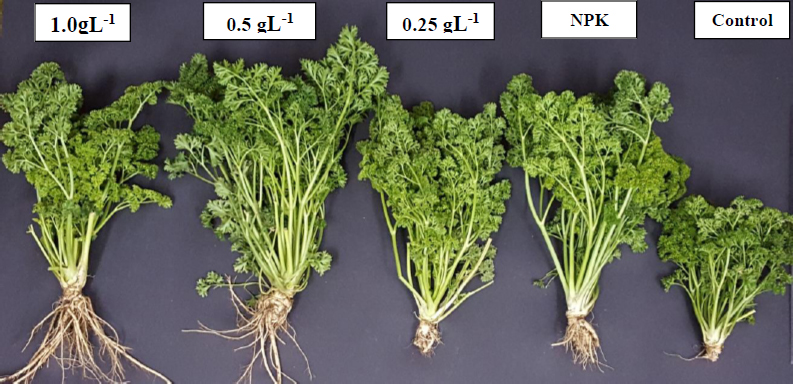
Effect of foliar spray with NPK normal solution and different concentrations of HAP NPs (0.25, 0.5, and 1.0gL-1) on curly-leafed parsley plants in the second growing season (after the first harvest of the second season).
| Season 1 | |||||||||
|---|---|---|---|---|---|---|---|---|---|
| 1st harvest | 2nd harvest | ||||||||
| Treat. | Plant height (cm) | Plant diameter (cm) | Fresh herb (t ha−1) | Dry herb (t ha−1) | Plant height (cm) | Plant diameter (cm) | Fresh herb (t ha−1) | Dry herb (t ha−1) | |
| control | 25.0 b | 29.3 ab | 10.40 c | 4.45 b | 16.0 b | 27.7 a | 11.93 c | 4.98 d | |
| NPK | 26.7 b | 31.0 ab | 17.23 b | 6.77 a | 16.7 b | 31.7 a | 13.90bc | 5.40 cd | |
| 0.25 | 30.1 a | 29.7 ab | 17.72 b | 6.59 a | 19.0 ab | 33.0 a | 15.93 ab | 6.19 b | |
| 0.50 | 33.7 a | 32.7 a | 21.13 a | 7.81 a | 21.0 a | 33.7 a | 17.57 a | 7.20 a | |
| 1.00 | 25.3 b | 25.3 b | 11.07 c | 3.64 b | 18.7 ab | 26.3 a | 14.50 b | 5.63bc | |
| Season 2 | |||||||||
| 1st harvest | 2nd harvest | ||||||||
| control | 20.0 c | 29.3 a | 12.20 b | 4.74 c | 15.0 b | 26.7 a | 11.73 c | 4.89 b | |
| NPK | 29.7 b | 31.3 a | 16.77 a | 6.31 b | 18.0 ab | 32.7 a | 13.51 b | 6.00 ab | |
| 0.25 | 28.0 b | 31.3 a | 15.59 a | 6.03 b | 17.3 ab | 29.3 a | 13.37 b | 5.19 b | |
| 0.50 | 34.7 a | 32.0 a | 17.52 a | 7.61 a | 21.0 a | 36.0 a | 17.37 a | 6.75 a | |
| 1.00 | 26.7 b | 27.2 a | 8.17 c | 3.84 d | 20.0 a | 25.7 a | 13.99 b | 5.83 ab | |
0.25: NK+ 0.25gL-1 HAP NPs, 0.50: NK+ 0.50gL-1 HAP NPs 1: NK+ 1gL-1 HAP NPs.
*Values with the same letters in each column indicate no significant difference between treatments at the 5% level of probability.
HAP NPs at 0.50gL-1 increased the fresh herb yield by more than 100% in the first harvest of the first season (21.13 t ha−1) compared to the control; however, this value was only an average of 46% in the remaining harvests. In contrast, the fresh herb yield of HAP NPs at 0.50 g L-1 increased by approximately 25% compared to that obtained from plants treated with NPK, except for the first harvest of the second season, where the differences were not significant. The HAP NPs treatment at 0.25gL-1 increased the fresh herb yield by 70 and 34% in the first and second harvests of the first season, respectively; whereas increases of 28 and 14% for the same respective treatments were observed in the second season compared to the control. No significant differences were observed in the fresh herb yield between plants sprayed with HAP NPs at 0.25gL-1 and NPK, as the latter treatment increased the yield by 66 and 16% in the first and second harvests of the first season, respectively, whereas increases of 37 and 15% for the same respective treatments were observed in the second season
0.25: NK+ 0.25 gL-1 HAP NPs, 0.50: NK+ 0.50 gL-1 HAP NPs 1: NK+ 1 gL-1 HAP NPs.
The positive impact of foliar spraying of HAP NPs on plant growth, crop yield, and production efficiency can be attributed to their enhanced ability to penetrate plant leaves and undergo efficient translocation throughout the plant, nanoscale size, and high surface area, which together enable controlled release kinetics at targeted sites. These properties make HAP NPs an effective and intelligent delivery system for enhancing phosphorus use efficiency and plant nutrient uptake, whether applied via root absorption or as a foliar fertilizer. Research has demonstrated that the sustained and slow release of Hydroxyapatite Nanoparticles (HAP NPs) provides a more readily available, efficient, and environmentally sustainable phosphorus (P) source than conventional fertilizers [8, 15, 36-39]. Moreover, the application of apatite nanoparticles as an alternative P source has the potential to enhance agronomic yields while mitigating the risk of eutrophication. Upon dissolution, HAP NPs release orthophosphate ions, the same form of phosphorus provided by traditional phosphate salts and the only form directly utilized in plant metabolism [8]. Additionally, their use may contribute to calcium nutrition and promote gibberellin hormone production in plants, thereby supporting growth and development [12].
The trend in dry herb yield was the same as that observed in the fresh herb yield, with both positively responding to fertilizer treatments. HAP NPs treatment at 0.50gL-1 presented the highest values of dry herb yield, ranging from 6.75 to 7.81 t ha−1, whereas the lowest values were produced by the control (ranging from 4.45 to 4.98 t ha−1) and HAP NPs treatment at 1g L-1 (ranging from 3.64 to 5.83 t ha−1). Enhanced plant growth has been observed with the application of nano-fertilizers compared to that with traditional NPK fertilizers. This improvement may be attributed, in part, to phosphorus (P) being a critical component of Adenosine Triphosphate (ATP), which plays a key role in storing and transferring energy. ATP is essential for a range of vital metabolic processes in plants, including photosynthesis, respiration, protein synthesis, glycolysis, and nutrient translocation and transport across plant cells. These processes also facilitate the transfer of genetic traits across generations. Additionally, calcium is involved in enzymatic and hormonal regulation, supports the uptake of other nutrients, and contributes to proper cell elongation and strengthening of cell walls [40].
Consistent with the studies’ findings, several reports have highlighted the positive effects of Hydroxyapatite Nanoparticles (HAP NPs) on the growth and development of various plant species. For instance [41], examined the impact of HAP NPs on Camellia oleifera seedlings and found that nanoparticles with a size of 200 nm significantly enhanced plant height, stem diameter, and biomass, followed by those of 20nm and 80µm. This improvement was attributed to the increased availability of phosphorus (P) in the rhizosphere, as well as higher concentrations of nitrogen (N) and phosphorus (P) in the leaves, particularly under unfavorable climatic conditions. An additional study investigating the effects of nano iron-containing NPK fertilizers on dragon’s head (Lallemantia iberica) plants reported significant improvements in plant productivity compared with traditional fertilizer treatments [42]. Similarly, Adansonia digitata (baobab) plants treated with Hydroxyapatite Nanoparticles (HAP NPs) demonstrated considerable enhancements in several growth parameters, including plant height, stem diameter, leaf number, leaf area, root length, and total dry weight, compared to those treated with conventional phosphorus fertilizers [43].
An increase in the concentration of HAP NPs beyond 0.50gL-1 led to a reduction in both plant height and diameter, resulting in lower fresh and dry herb yields. This decline may be attributed to the potential adverse effects of high concentrations of nanomaterial on plant growth. This reduction at a higher concentration of 1.0g L−1 Hydroxyapatite Nanoparticles (HAP NPs) reflects a typical dose-dependent response, in which low to moderate concentrations stimulate plant growth, whereas higher concentrations cause toxicity. This biphasic effect, often characterized as hormesis, has been documented in various studies on the phytotoxicity of nanoparticles. Elevated concentrations of nanoparticles can induce oxidative stress via the overproduction of Reactive Oxygen Species (ROS), impair stomatal function by physical blockage, and disrupt nutrient absorption and translocation within plant tissues [44, 45]. In contrast, lower doses applied under specific conditions have been shown to exert beneficial effects on plant development [46]. Similar effects on plant growth and phosphorus concentration have been observed with the application of apatite nanoparticles (HAP NPs) to lettuce plants, because of their small size and high surface-to-volume ratio [47]. These findings align with those of our recent study, which demonstrated that HAP NPs enhance growth and biomass production in Rosmarinus officinalis (rosemary) plants when applied via foliar treatment, outperforming traditional NPK fertilizers [30].
3.3. Essential Oil Yield and Composition
The oil content of curly-leafed parsley (on a dry mass basis) ranged from 0.08% to 0.21% in the first harvest and from 0.11% to 0.24% in the second harvest (data are not shown). As shown in Table 3, both HAP NPs and NPK fertilizers had significant impacts on essential oil yield (L h−1) during both harvests across the two seasons.
| Oil Yield (L h-1) | ||||
|---|---|---|---|---|
| Season 1 | Season 2 | |||
| Treat. | 1st Harvest | 2nd Harvest | 1st Harvest | 2nd Harvest |
| control | 9.72 b | 14.32 ab | 11.01 b | 13.28 c |
| NPK | 10.30 b | 11.58 b | 11.19 b | 12.16 c |
| 0.25 | 8.93 b | 16.93 a | 8.80 bc | 16.04 a |
| 0.50 | 14.88 a | 13.97 ab | 14.01 a | 15.63 ab |
| 1.00 | 7.80 b | 12.62 b | 6.53 c | 13.99 bc |
In the first harvest, the application of HAP NPs at 0.50gL-1resulted in the highest oil yield (14.01–14.88L h−1), outperforming the NPK treatment. However, in the second harvest of both seasons, the highest oil yield was observed with HAP NPs at 0.25gL-1, although this result was not significantly different from that obtained with 0.50gL-1. Increasing the concentration of HAP NPs beyond 0.50gL-1 led to a marked decrease in oil yield, with the lowest yields observed in these treatments being statistically similar to those of the control in most instances.
0.25: NK+ 0.25gL-1 HAP NPs 0.50: NK+ 0.50gL-1 HAP NPs 1: NK+ 1gL-1 HAP NPs.
*Values with the same letters in each column indicate no significant difference between treatments at the 5% level of probability.
The observed enhancement in oil yield under HAP NPs at 0.50 g L−1 and NPK treatments are primarily associated with the increased fresh herb yield rather than with changes in the essential oil percentage, as the latter was not significantly influenced by the treatments. In contrast, the oil yield per hectare was significantly affected, with the maximum yield recorded under HAP NPs at 0.50g L−1, indicating that treatment-induced improvements in biomass production were the main determinant of oil yield. This observation is consistent with the findings of [48], who demonstrated that the application of both nCp/HAP NPs and conventional phosphorus (P) fertilizers could enhance chamomile growth. In their study, both Cp-NH4+ and HAP NPs showed the highest average values for plant height, branch and sub-branch counts, flower numbers, phosphorus content, and both fresh and dry weights of flowers and shoots. These improvements in plant growth were subsequently reflected in higher oil and chamazulene yield. Additionally [49], reported that varying rates of NPK nano-fertilizers significantly enhanced the basil essential oil yield compared to the control group. Furthermore, both nano-fertilizers and nano-zeolites demonstrated superior effects on sage essential oil yield. However, nano-zeolites and nano-NPK fertilizers were more effective in improving essential oil productivity than single nano-phosphorus treatments. This improvement can likely be attributed to their influence on the availability of essential nutrients, vitamins, gibberellins, cytokinins, hormone-like compounds, amino acids, and sugars, all of which stimulate biochemical processes within the plant, leading to an increase in the production of volatile oils [50].
The aromatic profiles of curly parsley plant essential oil as affected by different fertilizer treatments included NK + 0.25gL-1 HAP NPs, NK + 0.50gL-1 HAP NPs, NK + 1.0gL-1 HAP NPs, a standard NPK solution, and a control (distilled water only) are detailed in Table 4.
| Compound | Ret. Time | Control | NPK | 0.25gL-1 | 0.50gL-1 | 1gL-1 | ||||
|---|---|---|---|---|---|---|---|---|---|---|
| 1st Harvest | ||||||||||
| α-pinene | 6.4 | 1.04 | 2.45 | --- | --- | 4.19 | ||||
| β-pinene | 8.6 | 0.52 | 1.53 | --- | --- | 2.59 | ||||
| β-Myrcene | 10.8 | 5.40 | 8.42 | 6.82 | 8.01 | 8.40 | ||||
| α-Phellandrene | 11.8 | 1.14 | 2.88 | 2.55 | 1.91 | 3.10 | ||||
| β-Phellandrene | 12.1 | 36.7 | 34.3 | 32.7 | 25.2 | 35.6 | ||||
| Terpinolene | 14.4 | 1.01 | 1.33 | --- | 1.03 | 1.40 | ||||
| 1,3,8-p-Menthatriene | 18.5 | 0.24 | --- | --- | --- | --- | ||||
| β-Elemene | 20.3 | 1.90 | 4.60 | 3.10 | 2.20 | 2.00 | ||||
| Germacrene D | 25.5 | 4.41 | 4.44 | 1.60 | 1.21 | --- | ||||
| cis-Dihydroagarofuran | 28.6 | 0.64 | 1.13 | --- | --- | 1.33 | ||||
| Isodaucene | 33.4 | 0.77 | 1.04 | --- | 0.80 | --- | ||||
| Myristicin | 49.2 | 34.6 | 26.3 | 42.1 | 56.7 | 40.1 | ||||
| Total | 88.37 | 88.42 | 88.87 | 97.06 | 98.71 | |||||
| 2n Harvest | ||||||||||
| α-pinene | 6.2 | 1.10 | 0.80 | 0.81 | --- | 2.45 | ||||
| β-pinene | 8.7 | 0.50 | 0.44 | 0.29 | --- | 1.52 | ||||
| β-Myrcene | 10.5 | 4.40 | 5.80 | 6.33 | 5.50 | 7.31 | ||||
| α-Phellandrene | 11.6 | 2.63 | 1.90 | 1.40 | 2.43 | 2.39 | ||||
| β-Phellandrene | 12.3 | 21.1 | 37.4 | 36.3 | 34.1 | 29.3 | ||||
| Terpinolene | 14.6 | 2.40 | 1.10 | 3.12 | 1.00 | 1.15 | ||||
| 1,3,8-p-Menthatriene | 18.7 | 2.90 | --- | 2.90 | --- | 0.81 | ||||
| β-Elemene | 20.5 | 3.68 | 1.79 | 2.72 | 2.97 | 3.18 | ||||
| Germacrene D | 25.2 | 0.42 | 1.39 | 0.75 | --- | 0.70 | ||||
| cis-Dihydroagarofuran | 28.9 | 0.72 | 0.44 | 0.41 | --- | 0.58 | ||||
| Isodaucene | 33.4 | 1.15 | 1.19 | 1.06 | 1.35 | 1.65 | ||||
| Myristicin | 49.2 | 29.7 | 45.1 | 34.2 | 49.7 | 45.8 | ||||
| Total | 70.7 | 97.35 | 90.29 | 97.05 | 96.84 | |||||
0.25: NK+ 0.25gL-1 HAP NPs, 0.50: NK+ 0.50gL-1 HAP NPs 1: NK+ 1gL-1 HAP NPs.
GC analysis of the essential oil constituents identified 13 compounds, accounting for 70.7 - 98.71% of the volatile constituents. All samples from the different treatments were characterized by the presence of myristicin and β-phellandrene as the main components. Considerable amounts of β-myrcene, α-phellandrene, β-elemene, and germacrene D were also detected. These results are consistent with those reported by [51], who identified myristicin (45%) and β-phellandrene (16%) as the primary constituents of curly parsley essential oil, followed by α-pinene, β-pinene, β-myrcene, α-phellandrene, terpinolene, β-elemene, germacrene D, cis-dihydroagarofuran, and isodaucene.
Data illustrated in Fig. (2) showed that the essential oil constituents of curly parsley plants led to the identification of myristicin (26.3-56.7%) and β-phellandrene (21.1-37.4%) as the main components in the two harvests.
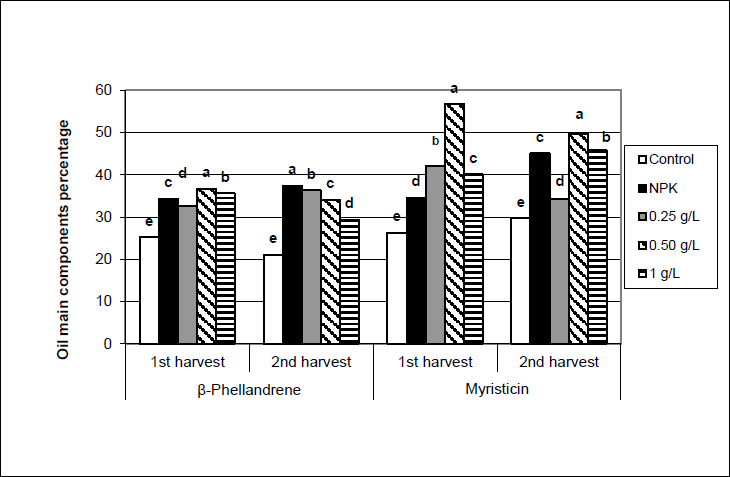
Effect of foliar spray with NPK normal solution and different concentrations of HAP NPs (0.25, 0.5, and 1.0gL-1) on oil main components percentage of curly-leafed parsley plants in the two harvests.
0.25: NK+ 0.25gL-1 HAP NPs, 0.50: NK+ 0.50gL-1 HAP NPs 1: NK+ 1gL-1 HAP NPs.
In our study, both nano-fertilizers and conventional NPK fertilizers enhanced the concentrations of myristicin and β-phellandrene compared to the control. The highest levels of these compounds were observed in the essential oil extracted from plants treated with HAP NPs at a concentration of 0.5 g L-1. An exception was noted for β-phellandrene during the second harvest, where the conventional NPK treatment yielded higher concentrations.
3.4. Leaf Anatomy
The anatomical measurements of the lamina and petiole of curly-leafed parsley plants sprayed with different treatments are presented in Table 5. Microphotographs depicting these treatments are shown in Figs. (3 and 4). Foliar spraying of HAP NPs and NPK normal solution had positive effects on the anatomical leaf measurements of parsley plants. In general, the results obtained from the HAP NPs foliar application showed improved leaf anatomical measurements (lamina and petiole) compared with those obtained from the NPK normal solution application.
| Treatments | |||||
|---|---|---|---|---|---|
| Characters | Control | NPK | HAP NPs | ||
| 0.25 | 0.5 | 1.0 | |||
| a- Lamina | |||||
| Upper epidermis | 20.0 c | 24.3 b | 18.5 d | 37.6 a | 19.8 c |
| Lamina thickness | 214.2 d | 210.6 e | 269.3 c | 295.1 a | 277.4 b |
| Palisade T.thickness | 51.5 e | 87.1 c | 115.1 c | 125.1 a | 123.6 b |
| Spongy T. thickness | 123.2 c | 88.0 e | 155.5 b | 170.3 a | 100.2 d |
| Vascular bundle thickness | 139.1 e | 142.8 d | 170.7 c | 172.2 b | 184.3 a |
| Xylem thickness | 32.4 e | 66.0 d | 77.3 c | 120.3 a | 106.3 b |
| Phloem thickness | 41.0 d | 52.7 c | 52.5 c | 82.2 a | 54.5 b |
| Gland diameter | 28.8 e | 45.1 d | 53.8 b | 68.7 a | 46.3 c |
| Main vein thickness | 486.1 e | 507.3 d | 617.1 c | 628.2 b | 645.7 a |
| Lower epidermis | 8.9 e | 11.8 d | 26.8 b | 28.6 a | 23.7 c |
| b. Petiole | |||||
| Epidermis thickness | 17.6 c | 18.7 b | 15.6 d | 22.8 a | 22.6 a |
| Collenchyma thickness | 89.4 d | 81.4 e | 104.1 c | 117.8 a | 110.3 b |
| Parenchyma thickness | 223.1 e | 350.7 a | 237.2 d | 263.5 b | 258.0 c |
| Xylem thickness | 180.9 c | 228.9 a | 166.0 d | 220.3 b | 141.5 e |
| Phloem thickness | 123.9 b | 121.1 c | 110.3 d | 146.7 a | 84.8 e |
| Pith diameter | 1707.3 c | 1425.9 e | 1725.8 b | 2008.1 a | 1625.1 d |
| Cross section diameter | 1961.8 c | 1705.6 d | 1964.2 c | 2391.8 a | 1996.5 b |
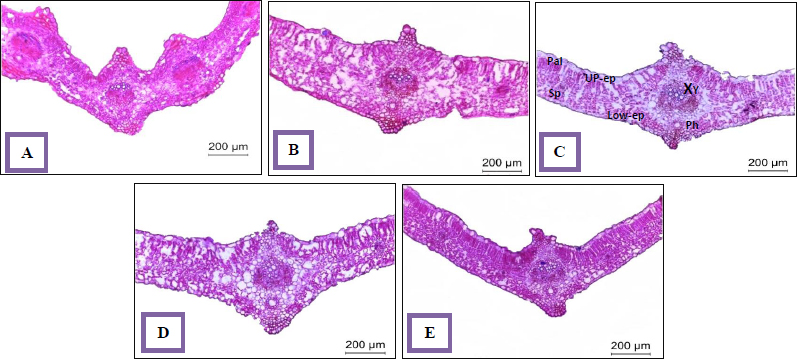
Cross sections of the leaflet lamina of curly leafed parsley. A: untreated plant (control). B-D: plants sprayed with different concentrations of HAP NPs 0.25, 0.5 and 1.0gL-1, respectively, E: plant sprayed with NPK normal solution. Note: Up-ep, upper epidermis; pal, palisade tissue; sp, spongy tissue; low-ep, lower epidermis; xy, xylem; ph, phloem.
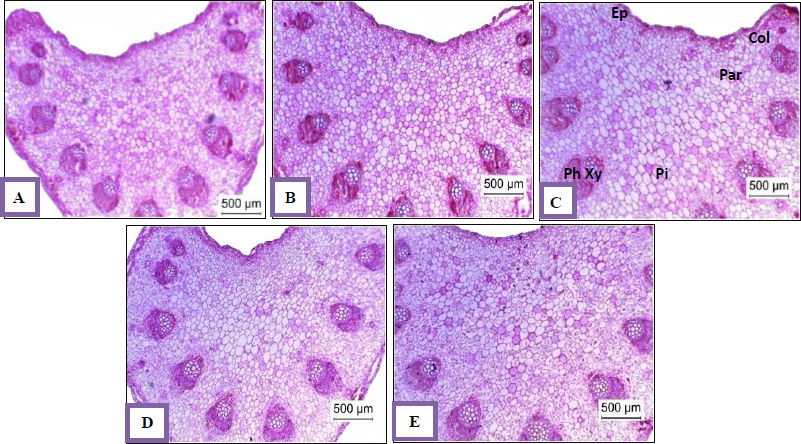
Cross sections through the petiole of curly leafed parsley. A: untreated plant (control). B-D: plants sprayed with different concentrations of HAP NPs 0.25, 0.5 and 1.0gL-1, respectively, E: plant sprayed with NPK normal solution. Note: ep, epidermis; col, Collenchyma Tissue; Par, Parenchyma Tissue; ph, phloem; xy, xylem and pi, pith.
0.25: NK+ 0.25gL-1 HAP NPs, 0.50: NK+ 0.50gL-1 HAP NPs 1: NK+ 1gL-1 HAP NPs.
*Values with the same letters in each row indicate no significant difference between treatments at the 5% level of probability.
3.4.1. Lamina
The mature leaves of curly-leafed parsley are pinnately compound with numerous leaflets (five to seven). Under a light microscope, the lamina of each leaflet comprises two epidermal layers (adaxial and abaxial) with mesophyll tissue between them. This mesophyll differentiates into a single palisade cell layer and spongy parenchyma consisting of four to five loosely arranged chlorenchyma cell layers containing intercellular air spaces (Fig. 3).
It is obvious from Table 5 that foliar spraying with HAP NPs led to an increase in lamina thickness at all concentrations; the highest thickness value was achieved by HAP NPs at 0.5 g L-1, namely, 295.1 µm, compared to 214.2µm for the control plants, whereas the lowest lamina thickness was observed in plants treated with NPK normal solution. In addition, the increase in lamina thickness was accompanied by an increase in the thickness of palisade and spongy tissues. The vascular bundle of the midvein increased in thickness for all treatments, with values of 170.7, 172.2, 184.3, and 142.8µm recorded under 0.25, 0.5, 1 g L-1 HAP NPs, and NPK normal solution, respectively, compared to the control (139.1µm).
[52] mentioned that particle uptake by leaves can occur in different manners. Nanoparticles enter leaves primarily via cuticular and stomatal routes, followed by transport through the symplastic or apoplastic pathways. Stomatal pores, typically measured in micrometers, serve as key gateways for nanoparticle penetration and distribution within the leaf mesophyll.
The oil gland is located below the vascular bundle of the midrib, which achieved the highest diameter when the leaves were treated with HAP NPs at a concentration of 0.5gL-1, with a value of 68.7µm compared with 28.8µm recorded in the control. The increase in the diameter of the secretory glands may be responsible for the increase in the essential oil content of parsley plants. However, Metcalfe and Chalk [53] mentioned that secretory canals contain a mixture of oil, resin, and mucilage. They are present in the pith, pericycle, and cortex of the petiole and extend into the lamina adjacent to the vascular bundles. These canals probably occur in all species of the Apiaceae family, and their arrangement, which is associated with the vascular bundles of the veins, is assumed to be of specific diagnostic value.
3.5. Leaf Petiole
As shown in the cross-sections in Fig. (4), the internal structure of the petiole consists of four main parts: the epidermis, hypodermis (collenchyma cells), ground tissue (parenchyma cells), and vascular bundles. In all treatments, the vascular bundles were arranged in a crescent shape, ranging between 9 and 11 bundles. Table 5 clearly shows that the foliar application of HAP NPs at 0.5gL-1 led to the highest recorded values for most of the anatomical petiole measurements of curly-leafed parsley, which were 22.8, 117.8, 146.7, 2008.1, and 2391.8µm for the epidermis, collenchyma, phloem thicknesses, pith and cross-section diameters, respectively. In contrast, the treatment with NPK normal solution produced the highest values for parenchyma and xylem thickness (350.7 and 228.9 µm, respectively) compared with the control and other treatments.
The improvements in anatomical leaf measurements in parsley plants may be due to the beneficial effects of nanoparticles, which have a high reactivity as they emerge from a greater density of reactive areas and more specific surface area [44]. Once nanoparticles internalize into the cell, they translocate via the apoplast or symplast pathways, traveling through the plasmodesmata of one cell to another and finally reaching the cytoplasm. Within the cytoplasm, nanoparticles are distributed across various organelles and engage in multiple metabolic processes [9]. The vascular tissues, xylem and phloem, facilitate nanoparticle transport, whereas accumulation primarily occurs in vacuoles and cell walls [54]. Nanoparticles approximately 43 nm in size exhibit significant integration into the internal cellular structures of the leaf, indicating the efficacy of nano-fertilizers in facilitating nutrient uptake [55].
While nano-fertilizer application could potentially enhance plant nutrient availability, improve agricultural yields, and decrease reliance on conventional chemical fertilizers, which often pose environmental and health hazards, there are concerns about associated toxicity. In fact, the toxicity, safety, and environmental effects of NPs remain largely unclear, as smaller particles can penetrate biological systems more effectively. The intrinsic characteristics of many NPs, such as their size, shape, surface area, charge, solubility, crystal phases, coatings, material types, and dosage levels, are believed to present potential health risks to humans. Moreover, environmental conditions such as temperature, pH, ionic strength, salinity, and organic matter can collectively affect the behavior, movement, and toxicity of NPs [56]. Many NFs are non-biodegradable, leading to their accumulation in soil and water, which can result in ecologically harmful substances that affect humans. Additionally, the manufacturing process might negatively impact the environment as NFs can be absorbed through the skin, lungs, and digestive system, posing health threats [57]. Consequently, it is crucial to thoroughly assess the ecological effects of large-scale NF production [58].
Within a defined concentration range dictated by the type and physical properties of the nanomaterials, an initial biophysical stimulus is generated. This stimulus results from interactions between cell surfaces and the charges, functional groups, or hydrophobic and hydrophilic components of the nanomaterial corona or exposed surfaces. At an optimal concentration, this initial stimulus enhances cellular metabolism and gene expression, resulting in biostimulation. Conversely, if the concentration deviates from this range, nanomaterials exhibit toxicity [59].
Nanomaterials exert various effects on microorganisms, including the production of Reactive Oxygen Species (ROS), direct damage to cell membranes, alterations in metal and metal-ion homeostasis, and genotoxicity. The cytotoxicity experienced by microorganisms is directly proportional to the concentration of nanomaterials to which they are exposed. Irrespective of the nanomaterial type, an increase in concentration correlated with reduced microorganism survival. Additionally, cytotoxicity is influenced by the specific type of nanomaterial used; for instance, even low concentrations of certain nanomaterials, such as copper iodide, can induce significant toxicity, whereas higher concentrations of other nanomaterials may result in a lower toxic impact [60].
CONCLUSION
An open-field experiment conducted over two consecutive seasons at the Experimental Station of the Faculty of Agriculture, Cairo University (Egypt), investigated the industrial production of curly-leafed parsley, primarily cultivated for export owing to its nutritional and health benefits, in neutral to slightly alkaline pH soil. The application of HAP NPs treatments demonstrated significant results. These results demonstrate that HAP NPs serve as an effective phosphorus fertilizer, enhancing plant yields to levels comparable to those achieved with conventional NPK fertilizers. The key findings focused on three critical aspects of parsley production and utilization: growth, yield, and essential oil output. Overall, it is recommended to apply HAP NPs to parsley plants at a concentration of 0.5gL-1, as this treatment resulted in the highest fresh and dry yields, exceeding 17 t ha-1 and 6.6 t ha-1, respectively. Additionally, the essential oil yield exceeded 15 L h-1. This treatment also significantly enhanced the thickness of various anatomical characteristics in the leaf and petiole, including the upper epidermis, lamina, palisade tissue, spongy tissue, vascular bundle, xylem, phloem, glands, epidermis, and collenchyma, compared to other treatments. The findings of this study underscore the potential of nano-fertilizer materials in the cultivation of medicinal and aromatic plants, with promising applications in industrial-scale production.
LIMITATIONS OF THE STUDY AND FUTURE RESEARCH DIRECTIONS
While the results show the considerable potential of HAP NPs for the cultivation of parsley, only a few restrictions merit critical discussion. First, the study was conducted in one experimental station in Cairo, Egypt, which means that the results are applicable primarily to neutral to slightly alkaline soils. The activity of hydroxyapatite nanoparticles may differ significantly in acidic or highly saline environments where the phosphorus release and the nanoparticles' stability may be altered. The two-seasonal period also provides a robust preliminary dataset, but long-term multi-annual studies are needed to assess the potential for soil nanoparticle accumulation and its consequent impact on the local ecosystem.
Future research should be prioritized from a safety and regulatory point of view; the study focuses on yield and structural anatomy but does not detail the nanoparticle residue in the final exported product to address consumer safety concerns. Furthermore, the above industrial production is an extrapolation from experimental station plots; further research is needed to assess the cost-efficiency and logistical feasibility of the use of 0.5 g L−1 HAP NPs on a large scale as opposed to the chemical NPK distribution.
Further investigation is required to evaluate the concentrations of nano and chemical fertilizers that accumulate in the soil, as these have not been quantified in existing studies. Such data would facilitate a comprehensive mechanistic understanding of the environmental fate, behavior, uptake, transport pathways, ecotoxicology, and persistence of nanofertilizers in soil. Metagenomics can be employed to explore the potential impact of nanofertilizers on soil microbiota. Furthermore, investigating the microbial signaling mechanisms of plants in response to interactions with nanofertilizers represents a promising research direction. Modeling the biological and biochemical interactions of nanofertilizers in soil, alongside their degradation, is essential for advancing sustainable agriculture.
AUTHORS’ CONTRIBUTIONS
All authors contributed equally to study design, experimentation, data analysis, and manuscript preparation. All authors have read and agreed to the published version of the manuscript.
LIST OF ABBREVIATIONS
| HAP NPs | = Hydroxyapatite nanoparticles |
| gL-1 | = Gram per litre |
| Lh−1 | = Litre per hectare |
| th−1 | = Ton per hectare |
| µm | = Micrometer |
AVAILABILITY OF DATA AND MATERIAL
All data generated or analyzed during this study are included in this published article.
ACKNOWLEDGEMENTS
Declared none.